R+S Group ($RSGN), the European leader in electricity transformers, reported strong numbers.
The thesis is playing well, rerating in progress. Still a long way to go 24 CHF today vs 40 CHF in September, when it was valued in line with its peers. Congratulations to those who bought at 17 CHF with us.
Overall, the new figures reinforce our constructive stance on the company.
Operational EBITDA reached cCHF85m, corresponding to a margin of c20.5%
What stands out most is the very strong free cash flow generation. FCF of CHF48m significantly exceeded the Bernberg CHF16m estimate, pointing to solid working-capital discipline and strong cash conversion from earnings.
Robust cash generation allowed the company to delever the balance sheet much faster than we expected, with net debt declining to CHF63m or just 0.7x EBITDA, compared with the Bernberg estimate of 1.1x.
Order intake of CHF477m in 2025 resulted in a book-to-bill ratio of around 1.15x and lifted the backlog to CHF326m, providing solid revenue visibility into 2026 and, to a degree, 2027.
We would be buyers, as the case is being derisked. We are fully invested up to our max positioning.
Read the previous post here on R+S Group – includes the full investment thesis.
R&S Group Holding AG (SWX: RSGN) is a rare beast in Europe’s energy transition. It designs and builds medium- and high-voltage transformers. Its footprint spans Switzerland, Poland, Croatia, Ireland, and Finland. It serves utilities, industrial clients, and renewable developers.
The company is sitting on a huge structural tailwind. Europe’s grids are old, and demand for electricity is rising faster than ever. Renewable energy integration, electric vehicles, and digital infrastructure growth are pushing the need for more reliable transformers. R&S has the plants, the product range, and the long-term relationships to capture all of this demand.
Here’s the quick take:
Structural tailwinds: Grid renewal, EVs, data centers, and decentralized renewables support multi-year growth.
Revenue visibility: CHF 320m backlog covers most of FY 2026 production.
Valuation: Trades at ~11× EV/EBITDA 2026E vs. 17× for peers. Berenberg’s CHF 40 target implies >100% upside.
Market overreaction: A 30% drop after an “immaterial” guidance update creates a high-conviction buying window.
Company Overview
R&S isn’t just another industrial manufacturer. It is a full-service transformer solution provider. Its six plants give it geographic reach, operational flexibility, and risk diversification across multiple countries. This is particularly important in a sector where lead times matter and supply chain disruptions can impact delivery.
The 2024 Kyte Powertech acquisition expanded its footprint into higher-voltage applications. Combined with its existing portfolio—from 50 kVA to 250 MVA, including dry-type, cast-resin, and oil-filled transformers—R&S is one of the few mid-cap companies in Europe that can offer a complete, end-to-end solution.
Long-term contracts with national grids, industrial OEMs, and renewable developers provide recurring revenue streams. These contracts give the company high visibility into both volume and pricing, which is particularly valuable in a capital-intensive sector like transformer manufacturing.
Structural Tailwinds
The growth runway for R&S is extremely visible:
Grid renewal: Roughly 30% of Europe’s electricity grid is over 40 years old. Transformers are critical for replacing aging infrastructure. Many of these grids were built in the 1970s and 1980s. Without updates, reliability risks increase, especially as energy demand surges. R&S is perfectly positioned to benefit.
Electrification & data centers: EV adoption, heat pumps, and data-center expansion are driving electricity consumption higher. This creates both volume growth and pricing power for transformer manufacturers. Companies with the capacity to scale production while maintaining quality are rare, and R&S is one of them.
Decentralized renewables: Tens of thousands of new connection points across Europe are required for solar, wind, and other renewable projects. Each connection requires medium- or high-voltage transformers. For R&S, this translates into repeatable, long-term demand, particularly for high-margin cast-resin and oil-filled units.
Berenberg estimates that European grid investment could exceed €12 billion through 2027. That is a multi-year runway for R&S’s core products, ensuring sustained visibility into both revenue and margins.
Competitive Advantages
R&S has built a durable competitive moat.
Pan-European footprint: Six strategically located plants reduce logistics costs, speed delivery, and provide localized customer support. This also limits disruption risk from any single country.
Full product range: 50 kVA–250 MVA, dry-type, cast-resin, and oil-filled transformers. Customers can get everything from one supplier, which increases stickiness and recurring business.
Technology edge: High-value cast-resin transformers command premium margins. They also meet stringent environmental and safety standards, which increasingly matter to utilities and industrial clients.
Operational efficiency: The Poland Krzeczów facility and ongoing debottlenecking projects boost throughput, shorten lead times, and increase profit. Scale matters in this industry, and R&S has been relentless in improving efficiency.
These advantages allow R&S to maintain top-quartile margins and pricing discipline even in competitive markets and despite low-cost competition from Asia.
Operational Momentum & Backlog
R&S has a diverse customer base spanning national grids, renewable developers, and industrial OEMs.
Key points:
Backlog: CHF 320m, covering most of FY 2026 production. This gives the company both revenue visibility and leverage in pricing.
Revenue growth: Expected CAGR of 10–13% through 2027, supported by both price and volume.
Capacity utilization: Near 100% at key plants, highlighting the importance of ongoing capacity expansion.
Strong backlog coverage also allows R&S to pass on raw material cost inflation through contracts. This reduces earnings volatility and ensures consistent cash flow.
Operational and Financial Highlights
Metric
2024
2025E
2026E
2027E
Sales (CHF m)
283
421
468
510
EBITDA margin
23.9%
21.8%
21.0%
21.3%
EBIT margin
22.2%
19.7%
18.8%
19.0%
EPS (CHF)
1.25
1.58
1.71
1.92
Net debt / EBITDA
1.4×
1.0×
0.7×
0.2×
EV / EBITDA (2026E)
~10.9×
Peers ~17×
—
—
Source: Berenberg Initiation (Oct 2025) and Flash Update (Nov 2025)
Operational KPI
Metric
FY 2023A
FY 2024A
1H 2025A
FY 2025E
Order backlog (CHF m)
268
295
306
310 (E)
Revenue (CHF m)
239
282
156
315 (E)
YoY Growth (%)
—
+18%
+10% H1
+12% E
Capacity utilization (%)
~92
>95
~100
~100
Source: Berenberg Initiation (Oct 2025) and Flash Update (Nov 2025)
Capacity Expansion
R&S’s growth and margin resilience come from strategic capacity expansion.
Poland (Krzeczów): +40% capacity, focusing on distribution and cast-resin transformers. Faster delivery, lower costs.
Croatia & Switzerland: Debottlenecking and automation upgrades to increase throughput and standardize components.
Ireland (Kyte Powertech): Higher-voltage capabilities and diversification of revenue streams.
Overall, output is expected to rise >50% by 2027. Most of this expansion is already covered by confirmed orders, minimizing execution risk while protecting margins.
Margin Evolution
Margins remain strong due to a combination of product mix, operational scale, and plant efficiency.
Metric
FY 2023A
FY 2024A
FY 2025E
FY 2026E
FY 2027E
EBITDA margin (%)
18.6
20.0
20.8
21.1
21.2
EBIT margin (%)
16.0
18.4
19.2
19.8
20.0
ROCE (%)
49
55
58
60
60+
Source: Berenberg Initiation (Oct 2025) and Flash Update (Nov 2025)
High-value cast-resin units and ongoing operational improvements in Poland ensure margins remain near 20%, a rare combination of growth and profitability for mid-cap industrials.
Financial Strength
R&S has cleaned up its balance sheet, creating optionality for investors:
Metric
FY 2024A
FY 2025E
FY 2026E
FY 2027E
Net Debt / EBITDA (x)
1.3
0.8
0.4
0.2
Equity Ratio (%)
11
22
30
36
FCF Yield (%)
3.4
4.9
5.5
6.1
Source: Berenberg Initiation (Oct 2025) and Flash Update (Nov 2025)
Disciplined capex (~3–4% of sales) plus strong free cash flow sets up M&A or dividend potential post-2026.
Valuation
R&S trades at a deep discount to peers, despite top-quartile margins and strong visibility.
Metric (2026E)
R&S Group
Peer Median
Premium / Discount
EV / EBITDA (x)
10.9×
17.0×
-36%
P / E (x)
14.5×
23.8×
-39%
FCF Yield (%)
5.5%
3.2%
+71%
Source: Berenberg Initiation (Oct 2025) and Flash Update (Nov 2025)
Berenberg’s CHF 40 target comes from a DCF (70%) and 13× EV/EBITDA multiple (30%). At CHF 18.82, upside is >100%, with FCF yield >6%.
Recent Sell-Off
On 6 November 2025, R&S issued an “immaterial” guidance update. The stock fell ~30%.
We see this as a buying opportunity:
Structural tailwinds remain intact.
Backlog coverage protects revenue.
Valuation discount widens the upside.
Market reaction was overblown. Fundamentals haven’t changed, making this an ideal entry point for long-term investors.
Risks
Macroeconomics: Slow GDP growth could delay grid investments.
Regulatory: EU energy policies or subsidies may shift, affecting renewable integration timelines.
Supply chain & commodities: Copper, steel, and insulation material volatility can temporarily impact margins.
Currency: CHF reporting vs. EUR costs introduces FX risk.
Execution: Simultaneous plant expansions could cause temporary margin pressure.
These risks are manageable thanks to backlog coverage, pass-through contracts, and geographic diversification.
Investment Case Summary
R&S is a pure-play, defensive growth compounder with strong upside potential.
Driver
Impact
European grid renewal & electrification
Multi-year growth tailwind
Full FY 2026 backlog
Revenue visibility & pricing power
19–20% EBIT margin
Top-quartile profitability
Rapid deleveraging
Room for M&A/dividends
35–40% discount to peers
Re-rating potential
High scarcity value
Few pure-play listed EU transformer peers
Source: Berenberg Initiation (Oct 2025) and Flash Update (Nov 2025)
Conclusion
R&S Group is a rare mid-cap in Europe with pure exposure to energy transition themes. Integrated products, strong margins, backlog visibility, and a healthier balance sheet make it both defensive and high-growth.
With >100% upside to CHF 40, the recent pullback is a high-conviction entry point.
Disclosure: The author’s family office holds a long position in R&S Group Holding AG. Analysis based on publicly available information, including Berenberg research (Oct 2025 Initiation and Nov 2025 Flash Update).
The goal of the blog is to provide investment ideas for further research. I/we have a beneficial position in the shares discussed above either through stock ownership, options, or other derivatives. I wrote this article myself, and it expresses my own opinions. I am not receiving compensation for it. I have no business relationship with any company whose stock is mentioned in this article. The article does not represent investment advice. Please do your own research before making any investment action.
EOS is the most accurate in killing drones with bullets and lasers.
We have never lost any competitive trial for drone killing. We have not lost to Americans, Israelis, or anyone. In a recent competition in Israel, we were the only ones to shoot down 100% of the drones.
Andreas Schwer, CEO of EOS
Please look at the previous posts on EOS on this blog to see the full investment thesis.
Last week, German Broker Montega organised a call with EOS CEO Andreas Schwer. Below are the main quotes from the call and the presentation.
We have never lost any competitive trial for drone killing. We have not lost to Americans, Israelis, or anyone. In a recent competition in Israel, we were the only ones to shoot down 100% of the drones.
We have been selected by the US Army to use our weapon station for the next generation of tanks. We are the sole partner for this project.
With a laser, we can kill up to 30 drones per minute. With a bullet, we can kill 4-5 per minute.
Germany wants to spend up to 40 billion euros to protect its airspace. Drone defence should be a big part of that budget. We will be bidding for the segment.
We are the only ones who can deliver a 100kW laser together with Rafael. Three different parties own Rafael´s laser IP. EOS owns all IP for its laser weapon.
We can kill drones flying up to speeds of 500km/h
We can kill drones up to 3 km with a bullet, laser up to 6 km and 8 km with rocket systems.
We have the widest portfolio of Remote Weapon Stations; no one else has such a broad product range.
The most popular system is Slinger, developed to kill drones.
The latest product is R500—the next-generation system with all AI functionality. We are developing this with the US Army. All new generation tanks will be equipped with such a system.
Rheinmetal is selling the Skyranger with a 35mm cannon for 7 times the price of our system. Its accuracy is similar to our system. Skyranger uses a 35mm cannon, while we use a 30mm cannon, which is the NATO standard.
Skyranger costs 14 million USD. For that, you can buy 7 of our systems, and with those 7 systems, you can protect many more assets than with one Skyranger. Our system is also much lighter, so it can be mounted on any vehicle. Our system can kill drones at the same rate as Skyranger. So 7 systems can kill 7x as many drones as Skyranger.
We are working on improving our AI capabilities. We are in advanced negotiations, and we may announce an exciting AI deal in the next few months.
Our current AI capability enables us to link several Remote Weapon Stations. If a fleet of drones comes, the AI system will decide which RWS will kill which drone.
Our first 100kW laser was sold to the Dutch at 71 million euros (125 Australian dollars)
We will have a laser partnership by Q1 2026 to capture the French market.
The German parliament stopped the Rhinmetal contract, because we could deliver the system at half price and half the time. We will bid for the contract next year in an open competition.
Many governments have reached out to us for quotes on the laser weapon. Sales would be conducted using the same documentation we used for the Dutch sale – it is a NATO-standardised contract that any NATO state can use.
High-energy laser weapon – we are in negotiations with several parties. We see laser weapon annual revenues of 1.5-2 billion Australian dollars within 3 years with 15-20% EBITDA margins.
Space control is our future. We are the most advanced in Europe at shooting down satellites. Only two US companies can compete, but they will not deliver outside the US. We are the only ones in Europe. This will be an even bigger business for us than laser in the 2030s.
Our partners – we have partners in most countries where we deliver:
In Germany, our partner for RWS is Deal, and for laser, it is Helsing. For Space warfare is OHT.
France, KMDS is the partner for RWS.
In the UK, we are partnered with MSI, and we can not disclose the partner
In Italy, we are partners with Leonardo
We are in negotiations with more than 10 governments regarding the sale of laser weapons.
We hope the Dutch will buy an additional laser weapon next year for testing by their navy.
We are planning to conduct live laser and cannon testing next year in the UAE. That can generate even more interest. We will be inviting many global potential customers. It will be a significant event.
All our laser IP is in Singapore. The reason is that it is easier to export IPO from Singapore than from any other country.
The most significant hurdle for our future growth is human capital. We have received unsolicited offers from top engineers from our competitors. We have hired those highly sophisticated engineers. The reason is that they wanted their products in real life.
We are valued at only 700 million USD. We have had a couple of takeover conversations. I cannot disclose more, but we can be bought out of the market. If any firm offers come, the board will come. We would not submit any offer to the board below 10 dollars.
If we secure a contract pipeline of 40-50 laser weapons, the share price will be well above $ 20.
We are still early into our growth story. Our objective is 40-50 dollars, so investors have not missed anything yet. We are still very early and very affordable.
Do look at previous posts for more details on the EOS investment thesis.
Disclosure:
The goal of the blog is to provide investment ideas for further research. I/we have a beneficial position in the shares discussed above either through stock ownership, options, or other derivatives. I wrote this article myself, and it expresses my own opinions. I am not receiving compensation for it. I have no business relationship with any company whose stock is mentioned in this article. The article does not represent investment advice. Please do your own research before making any investment action.
EOS has the most accurate weapon for killing drones. They have the most precise weapon that kills Russian drones in Ukraine. The stock sold off 48% from its recent all-time high, together with similar defence stocks.
EOS is our top idea for the following year. Our base case is that the stock should triple over the period. The driver will be the European Drone Wall, as well as additional sales of its laser drone weapon.
Below is a copy of an email sent out by Fearnley Securities.
What’s happened?
EOS has seen a sharp drawdown, off 48% from its recent $10.42 high à the momentum and sentiment that took it to these highs came following the announcement of their recent $125m HELW contract with the Netherlands, a NATO country. Management have also publicly referred to many additional HELW opportunities, with multiple countries enquiring about large scale orders; South Korea and other EU nations.
Management have long cited that progress towards peace deals in Ukraine and the Middle East may contest with the sentiment that has driven capital allocation to defence stocks globally, however the fact remains that drones and drone warfare are now seemingly entrenched in daily life for Russia, Ukraine, and remain in the headlines across all of Europe.
HELW state of play and opportunities:
Since the initial announcement of the 100KW HELW contract, EOS have since announced that their ‘Apollo’ HELW is scalable to 150KW. While we have not seen additional HELW contracts for EOS, we note that the advent of HELW purchasing is increasing, which in our view underscores that these weapons are now widely accepted as commercially scalable defence solutions, and will be a core part of all militaries moving forwards.
A reminder; traditional kinetic interceptors are economically unsustainable when $1,000 drones require $500,000 missiles for defeat à Russia’s 28th Sept attack on Ukraine saw 600 drones wreak havoc across Kiev à this comes at the same time the US is mulling approval of a $90bn funding package for Ukraine.
Multiple HELW systems are transitioning from prototype to operational deployment in 2025-2027 timeframe à But EOS remains one of the only suppliers who can deliver 150KW units:
Israel Iron Beam: End 2025
UK DragonFire: 2027 on Royal Navy ships
US Army IFPC-HEL: 2024 prototypes, mass production mid-2020s
EOS Apollo: 2025-2028 delivery to European NATO state
Reminder of the EU opportunity for EOS:
EOS controls over 90% of its HELW intellectual property in-house, delivering a fully ITAR-free solution – a critical differentiator that eliminates U.S. export restrictions and enables flexible licensing across all EU countries, this positions EOS to offer:
Turnkey technology licensing to EU member state defense contractors.
Co-production agreements establishing HELW production lines within EU borders à reminder that EOS has already licensed its technology through its partnership with Diehl Defence GmbH in Germany.
Sovereign capability development meeting EU procurement preferences for 60% European-sourced defense equipment by 2030, and 40% of defense purchases be made through joint contracts by 2027.
The recent European Drone Defence Initiative (EDDI), released on the 16th October, outlines EU$800bn of funding to be allocated to developing technologies such as High Energy Laser Weapons/Directed Energy Weapons in Europe.
Disclosure:
The goal of the blog is to provide investment ideas for further research. I/we have a beneficial position in the shares discussed above either through stock ownership, options, or other derivatives. I wrote this article myself, and it expresses my own opinions. I am not receiving compensation for it. I have no business relationship with any company whose stock is mentioned in this article. The article does not represent investment advice. Please do your own research before making any investment action.
ShaMaran Petroleum (SNM.ST, SNM.CA) is poised for significant upside following the reopening of the Iraq-Turkey pipeline and the new export agreement.
SNM’s netbacks are set to nearly double in 2026, with free cash flow expected to exceed $200 million, enabling debt repayment and potential dividends or buybacks.
With a rerating to 6x FCF, SNM shares could see 100% upside in 12 months, supported by strong cash flow and shareholder returns.
ShaMaran Petroleum Corp. is poised to benefit from the reopening of the Iraq-Turkey pipeline, which will facilitate the export of oil from the Kurdistan region.
The pipeline reopened over the weekend, but the share price did not move much. The announced deal was more complex than the consensus expected. I read any research I could find on the resumption, but I did not understand what was going on and why the share price was not doubling. I spent the time to investigate. My take is that the market does not appreciate what is happening.
Surprisingly, the brokers are not providing much help; the research reports are quite unclear.
Introduction to ShaMaran Petroleum
ShaMaran Petroleum Corp. (OMX: SNM.ST, TSXV: SNM.CA) is an independent oil and gas company that produces from two adjacent blocks in the Kurdistan Region of Iraq. Shamaran is part of the Lundin Group, and the Lundin family is the largest shareholder, holding around a 30% stake, as well as the largest bondholder.
The Lundin family provides significant support to ShaMaran. William Lundin, who is on the board, bought ShaMaran shares in December 2024.
ShaMaran indirectly holds a 50% working interest (66.67% paying interest) in the Atrush Block and an 18% interest (22.5% paying interest) in the Sarsang Block.
Both assets are operated by the Ross Perot, Jr. company, HKN. The Perot family has a prominent Texas-based business with strong ties to Kurdistan and the Trump Administration. ShaMaran doubled its working interest production last year to over 20k barrels per day.
ShaMaran’s market capitalisation is around $600 million, and its net debt is $90 million. The stock is listed on the Canadian and Swedish exchanges. It is quite liquid, with a daily trading volume of around $1 million.
Why was the pipeline closed, and why did the reopening negotiations take so long?
The 2023 closure of the Iraq-Turkey pipeline resulted from a dispute between the Kurdistan Regional Government and the Iraqi central government over how Kurdistan’s oil revenues should be collected and shared.
Before the agreement was announced in September, the Kurdistan government collected about 50% of the take from all oil produced in Kurdistan. At the same time, Kurdistan was not funded from the central state budget.
Under the new agreement, Kurdistan relinquished all its oil revenues and will instead receive its share of the federal budget. Kurdistan has 14% of the population of Iraq, so it will get 14% of the federal budget, which is more than they have been making from oil under the old regime.
There is a significant mistrust between the central Iraqi government and the Kurdistan Regional Government. A considerable amount of time was spent on establishing a procedure to monitor actual oil sales, ensuring that no revenues would be missed.
What prices were ShaMaran selling while the pipeline WAS CLOSED?
In the first half of 2025, Shamaran sold to local traders and achieved revenue per barrel of $32 – $35. From this amount, the Kurdistan government took about 50%, so the actual net amount returned to ShaMaran was $16-$17.50. With a net production of over 20k barrels of oil per day, that is over $100 million in annual cash flow for ShaMaran.
What prices is ShaMaran selling after the pipeline REOPENED?
The parties agreed to establish an interim three-month mechanism to build trust between them.
Under the mechanism, ShaMaran would collect an initial payment of $16 per barrel, less a $2 transportation fee. During these three months, the contracts will be reviewed by Wood Mackenzie consultants. The interim period is expected to conclude in December. Wood MacKenzie is tasked to produce a certification of the process. After that is completed, ShaMaran will get a retrospective payment of an additional net $16 per barrel, approximately. The retrospective payments for deliveries made in 2025 should be paid out during the first quarter of 2026.
From January 2026, ShaMaran and others will collect the full market price for their oil, as per their contracts (more than $32 per barrel net back for ShaMaran). In summary, by 2026, the net realised price is expected to almost double compared to 2025.
The net backs and cash flow numbers mentioned in the text are an approximation based on current Brent oil prices.
ShaMaran terms provide them with the market price (Brent) for their oil, adjusted for oil quality (API) and transportation costs, so them net backs and cash flow will fluctuate with the oil price starting now.
What will be the impact of the pipeline reopening on ShaMaran’s FCF?
ShaMaran is a very lean producer. The lifting costs are very low, at $3-$5 per barrel, and the maintenance capital expenditure is also low, at $2 per barrel. ShaMaran was able to generate very healthy cash flows, even from local sales.
ShaMaran’s guidance is to generate FCF of $100 million in 2025. The FCF in 2026 is expected to more than double, exceeding $200 million, which will enable the company to repay all of its debt, initiate dividend payments, and/or repurchase shares.
Who will repay the old receivable that ShaMaran has from the Kurdistan Government?
When the pipeline closed, ShaMaran had $102 million in receivables from the Kurdistan Government. It was agreed that the receivables would remain the responsibility of the Kurdistan government. The debt is already being repaid – from $95 million at the end of 2023 to $69 million at the end of 2024 to $53 million as of the end of June 2025.
The receivable represents approximately 60% of ShaMaran’s net debt position of $90 million as of the end of June 2025.
What are the risks?
ShaMaran has a very strong balance sheet. Its net debt is only $90 million as of June, vs its $600 million market capitalisation. With the strong cash flow generation, ShaMaran is expected to be net cash positive by the first half of 2026 at the latest.
The consensus expected that ShaMaran would start selling oil at double prices from day one. It did happen, but in a structured way. The market was not prepared for this, and many retail investors might not have fully understood the deal.
One year before the pipeline reopened, ShaMaran was trading at 4 times FCF. If the exact multiple is maintained after the new process is certified and net realisable prices double, the share price should rerate at least by 30%.
Historically, Kurdistan producers have traded at a discount due to the perceived risk that the central Iraqi government would not recognise Kurdistan oil exports. Now that the central government has recognised their contracts, and Iraq is in charge of Kurdistan’s oil exports, the discount should be removed.
If the share price were to rerate to 6 times FCF, the upside potential increases to 100%.
Strong cash flow generation should enable ShaMaran to start buybacks and/or dividends as early as next year. That should further support the rerating. We see 100% upside potential in the next 12 months.
FCF
P/FCF
Mkt cap
Share price
$ million
$ million
SEK
Before reopening
100
4
400
1.3
Today
100
6
600
1.9
2026
200
3
600
1.9
2026
200
4
800
2.5
2026
200
5
1000
3.2
2026
200
6
1200
3.8
Source: our calculations
Conclusion
ShaMaran is a well-run company from the respected Lundin group. The pipeline reopening should double the price ShaMaran can collect for its oil. The price increase should more than double its FCF and its valuation.
Strong FCF should enable the company to become net cash positive during the first half of 2026. I expect dividends or buybacks possibly already in 2026.
We are proud to announce that we have been ranked the #1 best-performing idea generator by SumZero over the Last Twelve Months (LTM) category.
SumZero is the premier online community exclusively for professional investors, bringing together hedge fund, mutual fund, private equity, and proprietary trading professionals.
SumZero hosts a platform of peer-reviewed, long-form investment research contributed by more than 16,000 buyside members. Members gain access to over 12,000 detailed theses on publicly traded securities, offering transparency with disclosure of analyst and fund names, thorough valuation, risks, catalysts, and defined investment timeframes.
After ranking in the top ten over recent months, it is the first time we have reached the #1 spot.
We invite you to subscribe for free and stay connected to our latest investment ideas, market insights, and performance updates.
Disclosure:
The goal of the blog is to provide investment ideas for further research. I/we have a beneficial position in the shares discussed above, either through stock ownership, options, or other derivatives. I wrote this article myself, and it expresses my own opinions. I am not receiving compensation for it. I have no business relationship with any company whose stock is mentioned in this article. The article does not represent investment advice. Please do your own research before making any investment action.
Congratulations to all who bought our EOS idea. We pushed it when EOS share price was around 1.3 Ausie dollars a year ago. It is 4.3 dollars today. Good move!
EOS announced today the historic first ever sale of 100 kW laser weapon. Nobody ever sold such a strong laser weapon. Historical achievement. The share price is 43% up today.
There is a lot of further catalysts this year. I would not be surprised if the share price would break 10 dollars this year.
Nebius Group remains our core AI play, with strong management and the potential for multi-year value creation.
Electro Optic Systems is poised for explosive growth, with major contracts expected to drive significant upside in 2025.
ShaMaran Petroleum offers a catalyst-driven opportunity; pipeline reopening could push the share price higher imminently as negotiations conclude.
Vicore Pharma is our top idea for 2026, with very material upside potential.
PM Images
Our family office is experiencing one of its best years. It is mainly thanks to several stocks that I wrote about here on Seeking Alpha.
I would like to provide an update on the ideas I wrote for Seeking Alpha and update my positioning on those.
Nebius Group
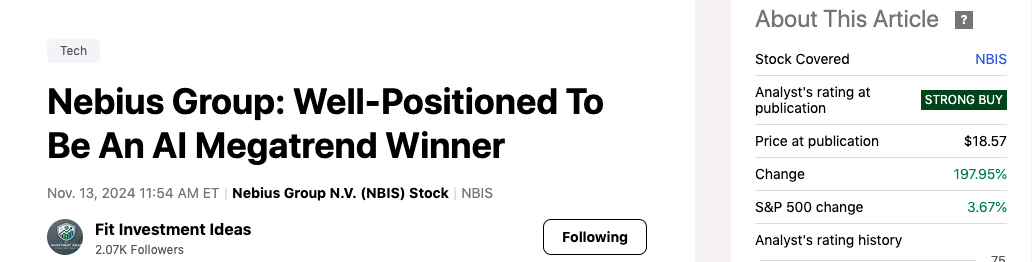
Nebius Group N.V. (NASDAQ: NBIS) has been one of my top-performing ideas this year. I was one of the first to write about Nebius on Seeking Alpha in mid-November 2024. Since then, Nebius has returned almost 200%.
Nebius (SeekingAlpha.com)
Following my initial article, I wrote four updates on Seeking Alpha on Nebius.
We have not sold any Nebius stock, and it has grown into the most prominent position in our family office. We bought Nebius at $10 OTC before it was listed. Today’s price is $53.
Nebius Investment Case
Nebius remains our core AI play. I believe AI is the biggest Megatrend since the internet and represents the most enormous value-creation opportunity of our lifetime.
It is very difficult to guess who the winners of the AI Megatrend will be. In my view, Nebius is one of the contenders.
The management team had already built a $30 billion business to abandon in favour of establishing Nebius. The management team has a strong track record of innovating around its core business – in Yandex they built the whole ecosystem around the core search engine business, that dominates the whole Russian-speaking world. They are already doing the same in Nebius. The company is transitioning from an AI data centre provider to an AI ecosystem provider. They are at the forefront of AI developments and are innovating in new areas where they have an opportunity to spot emerging trends early. That is why we are staying invested in Nebius.
Back-of-the-envelope peer valuation
Coreweave has a market capitalisation of $80 billion and an enterprise value of $97 billion. Goldman Sachs estimates CoreWeave’s 2025 revenues at $5 billion. This means that CoreWeave’s capital is trading at approximately 20 times its revenue.
Nebius’ current enterprise value is about $11 billion (assuming the company spent only $0.5 billion in Q2 and that the proceeds from the $1 billion debt issue remain unspent).
Coreweave
Market Capitalization
$80 Billion
Net Debt
$17 Billion
Enterprise Value
$97 Billion
Goldman Sachs 2025 Revenue estimate
$5 Billion
EV/Sales
19.40
Nebius
Market Capitalization
$12 Billion
Net Debt
-$1 Billion
Subsidiaries and holdings
$6 Billion
Enterprise value of the AI Datacenter Business
$5 Billion
Nebius’s 2025 AI Data center Revenue Guidance
$0.7 Billion
EV/Sales of AI Datacenter Business
7.14
Source: our calculations
We have compiled the table above to illustrate Nebius’s undervaluation. Please note that the result is very indicative, as I deduct the full value of Nebius’s subsidiaries to calculate the enterprise value of Nebius’s AI Datacenter business. That approach would mean that the market gives Nebius full credit for the valuation of its subsidiaries. I am not sure if this is the case.
I wrote an article comparing Nebius vs CoreWeave. I concluded that Nebius is a much better company than CoreWeave. The table above indicates material upside for Nebius to catch up to CoreWeave multiples.
My base case is for Nebius to double this year, with the central thesis being the longer-term value creation. Nebius is one of those companies which you may look at in five or ten years and see how many times the company has multiplied your original investment. Similarly, people look at today’s internet success stories.
The main risks to the thesis are macro turbulence and slow AI innovations by Nebius. Macro disruption would only delay AI by making it more difficult for companies to access capital. I am comfortable with Nebius’s ability to innovate, given the strong track record of its management team and Nebius’s performance over the last year. The extraordinary value creation management achieved in the previous two years – Nebius’s Enterprise value of $13 billion is the best proof.
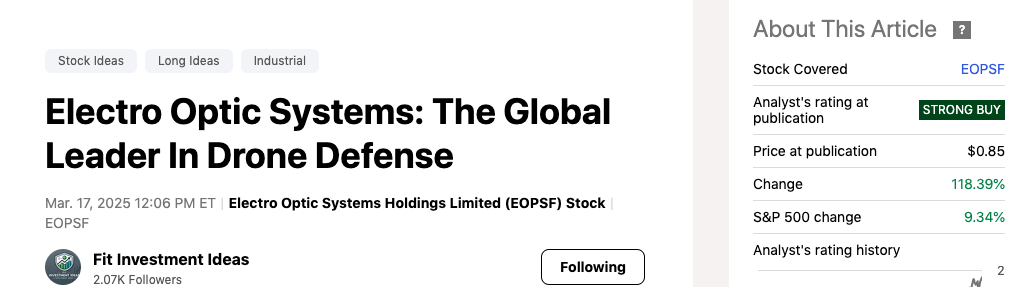
I wrote an article on EOS in mid-March 2025. In three months, the idea generated a return of ~120%.
EOS (SeekingAlpha)
I believe we are in the early innings. My price target for the 2025 year-end is A$10, vs. the current share price of A$2.80.
The company has a $1.5 billion backlog of orders in negotiations. Surprisingly, despite the war, armies did not speed up their procurement processes. Despite that, I expect EOS to sign the first-ever contract for laser weapons against drones in the next few months. EOS will be the first company ever to sell such a strong laser weapon. The share price could easily double on the announcement.
There are multiple large contracts in finalisation for this year. I believe 2025 will be a very good year for EOS and its shareholders. And 2026 should be even better. Read the article for details and check their website for their excellent presentation and quarterly webcast.
The future for EOS is laser. They have been developing lasers for 40 years. The company claims it can shoot down a coin from Earth’s orbit with a laser. There is a very material value creation opportunity in EOS’s laser business.
The main risk is competition. EOS is two years ahead in the accuracy of its “bullet” anti-drone devices. The laser advance might be even stronger. The stock is currently so cheap because investors are still not fully confident in EOS’s ability to leverage its technological advantages into contracts. I believe that 2025 will be the turning point for EOS. The share price movement over the last two months indicates that many investors also believe this.
ShaMaran Petroleum
ShaMaran Petroleum Corp. (OTCPK:SHASF), (SNM:CA) is an independent oil and gas company that produces from two adjacent blocks in the Kurdistan region of Iraq. ShaMaran belongs to the Lunding family holdings.
ShaMaran is a play on the reopening of the Kurdistan-Turkey oil pipeline, which has been closed for the last two years due to local disputes. Now the Trump administration is pushing for the pipeline to reopen, which has the potential to double the ShaMaran Petroleum share price.
The meetings between the Iraqi government and the Kurdistan Regional Government (KRG) will conclude today, with draft agreements set to be presented to the Iraqi Council of Ministers on Tuesday, paving the way for the resumption of oil exports and the disbursement of civil servant salaries in the Kurdistan Region, sources familiar with the matter told Zoom News on 6/30/2025
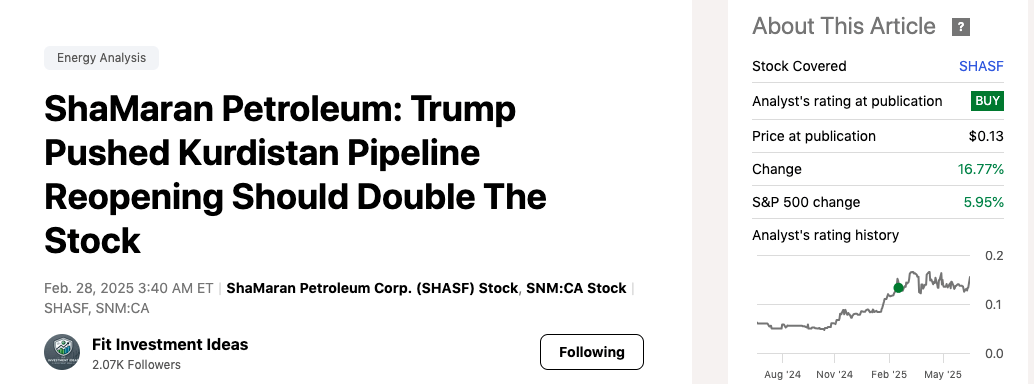
Since I wrote the ShaMaran article at the end of March, the stock has increased by 16%. I believe the catalyst could materialise at any time, which could potentially double the share price.
ShaMaran (SeekingAlpha)
The investment case is based on a political resolution that is outside ShaMaran’s control. Further there are many additional risk issues related to the pipeline reopening – namely the payment terms, and repayment of overdue balances (ShaMaran is owed $80 million). An additional risk is a new geopolitical instability in the region.
Buy Vicore, Sell Pliant
I am very bullish on Vicore for 2026.
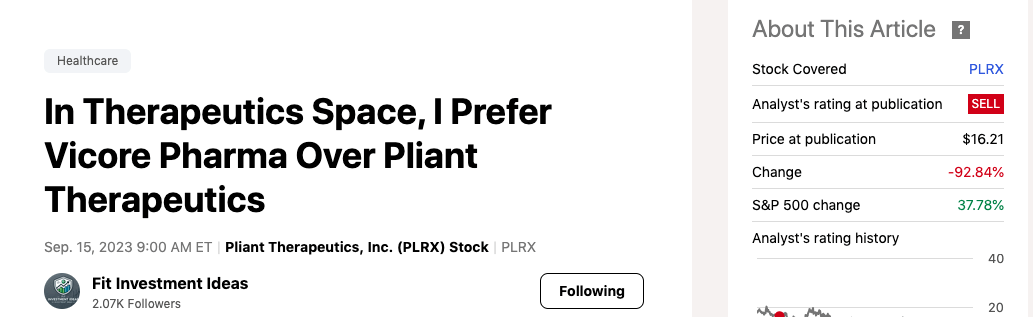
In the article In Therapeutics, I prefer Vicore Pharma over Pliant Therapeutics. I introduced Vicore Pharma (STO: VICO) and compared it to the US-listed Pliant Therapeutics, Inc. (PLRX).
The article’s point was that the US-listed Pliant was 12 times more expensive than Sweden-listed Vicore while having materially worse results. The article recommended buying Vicore and shorting Pliant.
The Pliant short thesis is playing well. The Pliant short generated a 96% return.
Long Vicore Pharma (SeekingAlpha)
Vicore might be one of the most promising stocks in our portfolio for 2026.
IPF is not a curable disease at the moment. There were two drugs which sold more than $3.5 billion in 2021. Both drugs have incomparable results in comparison with Vicore. Both only delay the disease by weeks or a single month.
Vicore has the best results ever of any company in Idiopathic Pulmonary Fibrosis (IPF). Nobody has ever achieved such results as Pliant showed in the 2b study. The 2a study results indicated that Vicore may make IPF a curable disease.
The $3.5 billion price tag represents a 20x multiple of Vicore’s current share price. That is if Vicore’s results would only delay the disease by weeks as the others did. If the 2a results were achieved again, Vicore might be able to gain an even higher valuation.
Some top US pharma investors are involved.
Nothing much will happen during 2025 with Vicore as the 2b study results are expected mid-next year. All eyes on 2026!
The major risk is that the 2b study results are materially worse than its 2a results. Vicore’s advantage is, that the bar is very low. As mentioned above the two drugs that sold for $3.5 billion in 2021 only achieved delay in the disease for weeks. For Vicore, a bad result would be to be on par with these. Not a bad upside.
Golar LNG
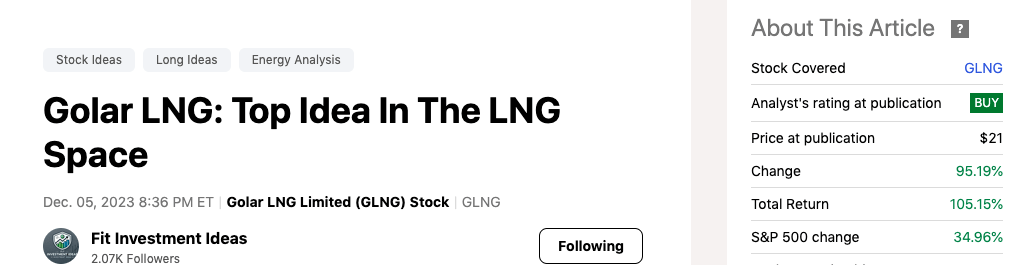
Golar LNG Limited (GLNG) builds, owns, and operates marine infrastructure for the liquefaction and regasification of LNG. It currently owns two out of nine existing FLNG ships in the world, which positions it perfectly for the projected LNG deficit in Europe.
We wrote the article in December 2023. Since then, the idea returned over 100%.
Golar LNG (SeekingAlpha)
We are out of Golar now. I do like the stock. I have traded it several times. Whenever there is a market pullback, we buy Golar and sell it around these levels. Whenever the opportunity arises, we will repeat the trade.
The primary risks are accidents, production disruptions, and fluctuations in LNG pricing. A sudden increase in LNG supply would decrease the market component of the payments.
Link Mobility
LINK Mobility Group Holding ASA (OTCPK: LMGHF) is Europe’s largest company in helping other companies and state institutions communicate with their customers through SMS, WhatsApp, Viber, Instagram, and other messaging platforms. If you fly and get a boarding SMS, it could be from LINK.
It is a solid company growing organically and through acquisitions. We wrote an article in late January 2024 when the share price was around 17 NOK. Today the share price is 28.6 NOK, generating around 60% return. We remain invested as the company keeps delivering.
The primary risks for Link Mobility are margin pressure and integration risks. The company has successfully integrated over 35 acquisitions. I consider the acquisition risk to be low. Most of the profits the company generates come from markets where it holds a dominant position. The fact that it is the largest European company gives it a competitive advantage of massive scale vs. its peers.
What is Next
I am now working for a company that has tremendous upside potential. Based in Sweden, annual revenue growth of 400%, no debt, highly profitable, cheap at 5 times EBIT, and almost no research coverage. I visited the company last week. I find it very attractive, and I’m already writing an article. Stay tuned.
Editor’s Note: This article discusses one or more securities that do not trade on a major U.S. exchange. Please be aware of the risks associated with these stocks.
Disclosure:
The goal of the blog is to provide investment ideas for further research. I/we have a beneficial position in the shares discussed above either through stock ownership, options, or other derivatives. I wrote this article myself, and it expresses my own opinions. I am not receiving compensation for it. I have no business relationship with any company whose stock is mentioned in this article. The article does not represent investment advice. Please do your own research before making any investment action.
Electro Optic Systems (EOS), an Australian defense firm, is at the forefront of counter-drone technology. With a significant portion of its market capitalization held in cash and no debt, the company is poised for strong growth.
EOS boasts a robust A$2 billion contract pipeline, with key deals in advanced negotiations, each of which could substantially enhance its valuation.
The company’s cutting-edge solutions, including the Slinger and R500, offer unparalleled precision in neutralizing drones, positioning EOS as a crucial player in modern military technology.
With solid financials and a promising contract outlook, EOS presents a compelling investment opportunity with high upside potential and relatively limited downside risk.
The Drone Defense Leader
Electro Optic Systems (OTCPK:EOPSF) (EOS:AUS), based in Australia, specializes in counter-drone technology using both bullets and lasers. The company promotes itself with the slogan:
“Nobody kills drones like EOS”
Listed on the Australian Stock Exchange, EOS has a market capitalization of A$240 million and a pro forma cash balance of A$178 million with zero debt. This means that 75% of its market capitalization is in cash, resulting in an enterprise value of just A$62 million.
The company stands to gain from geopolitical instability and evolving warfare tactics. Drones have become a dominant tool in modern conflicts, and EOS is positioned to capitalize on this shift.
Advanced Hard-Kill Technology
EOS has developed some of the most precise “hard-kill” systems available, capable of eliminating drones using bullets or lasers. The company claims to offer the most accurate drone neutralization solutions in the market today.
Future is Laser: EOS has developed laser technology capable of shooting down objects the size of a coin from orbit. Its laser-based counter-drone systems are already commercially available.
Europe’s Military Spending Surge: The war in Ukraine has driven record-high defense investments across Europe, positioning EOS to benefit significantly.
Drones Reshape Warfare
Russia’s War on Ukraine has underscored the effectiveness of drones in combat. The increasing use of drones has fundamentally altered the battlefield:
“For just $1,000, you can deploy a drone to attack assets worth $10 million, $100 million, or even $1 billion. High-value targets no longer require massive expenditures.” — Clive Cuthell, EOS COO
The use of drones has skyrocketed. For example, in the latter half of 2024, Russia quadrupled its drone attacks against Ukraine, launching 1,400 drone strikes in October alone.
Counter-Drone Defense: The Cost Problem
“An enemy can launch hundreds or even thousands of drones at once. Dealing with such saturation is extremely difficult.” — Clive Cuthell, EOS COO
This swarm strategy was demonstrated in Iran’s 2024 drone attack on Israel, highlighting the cost imbalance of counter-drone warfare. Many nations, including Ukraine, initially had no choice but to use $100,000 missiles to shoot down $1,000 drones—an unsustainable defense model.
The only practical solution is cost-effective drone defense, and bullet-based countermeasures are the most efficient. EOS has established itself as the global leader in “hard-kill” anti-drone systems.
EOS: A Deep Dive
Originally founded as a government research institute focused on optics and laser technology, EOS became a private company in 1983 and has been publicly traded since 2000.
Today, the company operates in almost 20 countries, with manufacturing facilities in the US, UAE, and Australia, and a newly established laser innovation center in Singapore. With a global workforce of 350 employees, EOS continues its European expansion in 2025.
Key Leadership:
Dr. Andreas Schwer, CEO since July 2022, formerly led Rheinmetall Defense and worked at Airbus and Manitowoc.
Previously, Dr. Schwer spent three years advising Saudi Crown Prince Mohammed bin Salman on the country’s defense industry development.
Under his leadership, EOS streamlined operations, divested non-core assets, and launched new products. The last of these asset sales, EM Solutions, yielded A$158 million, representing a profit of A$132 million, over 50% of EOS’s market cap.
With a net cash position of A$128 million as of January 2025, EOS expects its cash balance to rise to A$178 million, representing 75% of its market capitalization—funding its A$2 billion contract pipeline.
Unmatched Drone Defense Capabilities
EOS’s core products include:
Remote Weapon Systems (RWS) – including the newly launched R500 AI-driven system.
High-energy laser weapons – first-ever commercial sales secured in 2024.
Space warfare technologies – laser tracking and satellite disruption capabilities.
Key Differentiator:
Superior accuracy – In recent tests, EOS systems shot down 100% of drones, while the second-best competitor achieved only 75%.
AI-Driven “Iron Dome” System – EOS’s R500 RWS can autonomously coordinate drone defense without human intervention.
EOS in Ukraine
EOS has over 190 Remote Weapon Systems deployed in Ukraine.
A new A$181 million contract is under negotiation.
Financial Performance & Growth Outlook
2024 Revenue: A$259 million (+17% YoY)
Gross Margins: 46%
EBITDA: A$13 million
2025 Revenue Guidance: A$160 million (flat YoY), with additional contracts in progress
A$2 Billion Contract Pipeline
EOS’s contract backlog as of December 2024 was A$136 million. The company has never lost a contract bid, and its A$2 billion pipeline includes:
UAE R500 contract (~A$500 million) – EOS’s largest contract ever, expected in 2025.
EU NATO laser weapon contract (A$50-100 million) – first commercial laser weapon deal.
Hanwha RWS contract (A$100 million) – conclusion expected in early 2025.
EOS trades at a 0.4x EV/order book, compared to industry peers at 1.0x. If EOS secures its A$500 million contract and the multiple rises to 0.6x, the Enterprise Value would jump to A$380 million, implying a market cap of A$550 million—130% above current levels.
Price Target for 2025: A$4-5 per share, compared to the current A$1.25 per share.
Conclusion
Modern warfare is defined by drones, and EOS is the best at eliminating them. With a record A$2 billion contract pipeline, a debt-free balance sheet, and cash covering 75% of its market cap, the risk-reward balance is highly favorable.
With upcoming contract announcements, EOS has the potential for major upside revaluation. The future of warfare lies in lasers and space, and EOS is leading the charge.
The goal of the blog is to provide investment ideas for further research. I/we have a beneficial position in the shares discussed above either through stock ownership, options, or other derivatives. I wrote this article myself, and it expresses my own opinions. I am not receiving compensation for it. I have no business relationship with any company whose stock is mentioned in this article. The article does not represent investment advice. Please do your own research before making any investment action.
At today´s SpareBank conference – there was a Kurdistan panel. The most interesting and the most exposed to the reopening of the Kudistan pipeline is the Lundin company Shamaran Petroleum. The pipeline reopening is pushed hard by Trump and could happen as early as next month. I enclose below my notes from the SpareBank conference on Shamaran:
Summary of the ShaMaran CEO Garrett Sonden’s presentation at the Sparebank conference
ShaMaran is a Lundin Group company; The Lundin family is the largest shareholder (~30%) and the largest bondholder.
• Lundin provide Shamaran significant support – William Lundin, who is on our board, bought ShaMaran shares in December 2024
We produce over 100 million USD in Free Cash Flow per year, even with our current local sales at ~50% discount to global market prices.
If the pipeline reopens, our FCF should at least double
Our market capitalisation is almost 400 million USD
We have a net debt of 130 million USD, which we are reducing at ~25 million USD per quarter
We have repaid over 100 million USD of debt in the last 13 months, and if the pipeline reopens, our debt repayments will accelerate.
If the pipeline reopens, we can soon start dividends and/or share buybacks.
The market does not give us any credit for our receivables. We have over 80 million USD receivables at September 30, 2024, which we believe we will collect 100% from the Kurdish government over time.
We have two producing assets in Kurdistan. Both assets are operated by the Ross Perot, Jr. company, HKN. The Perot family has a prominent Texas-based business with strong ties to Kurdistan.
We doubled our working interest production in the last year to over 20k barrels per day.
We are getting good payment terms from the local sales – we have no receivables, and purchases are often prepaid.
Most prominent players left Kurdistan, but we still see a good consolidation opportunity among the smaller players in the region.
We are the only one with a mandate to explore consolidation in Kurdistan, and we have a track record of making three acquisitions over the last six years.
Our stock is very liquid – 90% of the trades occur in Stockholm, with 1 mln USD average daily trading volume.
My take on valuation:
Sparebank analysts at the start of the presentation mentioned that after the pipeline reopens, the stocks should trade at PE of 3-6.
He believes the pipeline should be in operation early in the 2H25. The Bloomberg article below would indicate an earlier reopening.
For simplicity, lets take FCF as Earnings.
The stock now trades at 4 times FCF.
Assuming the stock will trade at 3 times FCF after the pipeline reopens, the market capitalisation would increase by 50% to over 600 million USD at 3 times FCF. This means the share price should be 2.2 SEK, a 50% upside from the current share price.
If the pipeline reopens and Shamaran continues trading at 4 times FCF, the share price will double to 3 SEK.
IF the higher end of the analyst’s PE range was achieved, the company would be trading at 6 times 200 mln FCF, which is 1.2 bln. That would correspond to 4.5 SEK per share.
Latest ShaMaran presentation from the Sparebank conference:
The goal of the blog is to provide investment ideas for further research. I/we have a beneficial position in the shares discussed above either through stock ownership, options, or other derivatives. I wrote this article myself, and it expresses my own opinions. I am not receiving compensation for it. I have no business relationship with any company whose stock is mentioned in this article. The article does not represent investment advice. Please do your own research before making any investment action.


 Fit Investment Ideas