Allied Gold (AAUC) is Africa’s fastest-growing gold producer. The takeover that was supposed to close this year collapsed in July, the stock fell roughly 45% from the bid price, and what’s left is a business generating serious cash at a valuation that doesn’t reflect it.
The production ramp is the story:
- 2025: 379 koz
- 2026 guidance: 485–575 koz — 40% growth at midpoint
- 2027 guidance: 640–680 koz — 75% above 2025 at midpoint
Three countries: Mali, Ethiopia, Côte d’Ivoire.
What happened
In January, Zijin Gold bid C$44 per share in cash. That was roughly a 5% premium to the undisturbed price of C$41.50 — thin, and worth remembering.
Shareholders approved in April. Then things started going difficult.
The problem surfaced on 29 May. Rather than closing, the companies announced a two-month extension — and the Financial Times reported why: China’s National Development and Reform Commission had not cleared the deal. Canadian and West African regulators had already signed off. Beijing was the only holdout.
From there the stock bled steadily. The market was pricing a rising probability that the deal died, and it was right to.
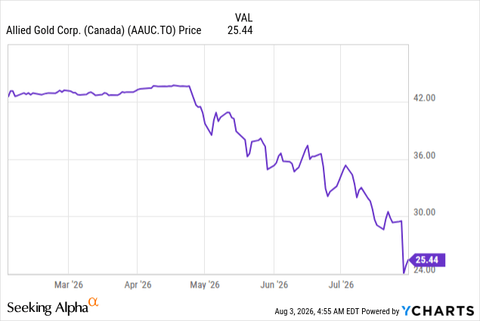
On 29 July the two sides let the deadline expire, agreeing there was no reasonable likelihood the remaining conditions would be met. Allied fell 18% that morning to C$24.27, valuing the company at just over C$3bn. No break fee either way, as the breakup was due to regulatory issues.
Zijin announced it bought 12.8m newly issued shares at C$32.55 — a 10% premium to the 30-day VWAP — taking a 9.2% stake for US$295m.
That last point deserves emphasis. The acquirer who just walked away chose to buy in at a price well above where the stock trades today. Zijin didn’t lose conviction in the asset. It lost an argument with its own regulator.
The numbers
| Key ratios | 2024 | 2025 | 2026E | 2027E |
|---|---|---|---|---|
| Market cap (US$m) | 1,519.9 | 2,276.1 | 2,512.9 | 2,512.9 |
| EV (US$m) | 1,391.2 | 1,950.6 | 1,831.6 | 666.9 |
| EBITDA (US$m) | 211.1 | 457.5 | 1,251.5 | 1,627.4 |
| Net cash / (debt) (US$m) | 128.6 | 325.5 | 681.3 | 1,846.0 |
| Free cash flow (US$m) | −83.9 | 81.9 | 225.3 | 1,164.7 |
| EBITDA margin | 32% | 40% | 63% | 66% |
| EV/EBITDA | 6.6x | 4.3x | 1.5x | 0.4x |
| P/E | −68.1x | 922.3x | 4.0x | 2.7x |
| FCF per share (US$) | −0.3 | 0.7 | 1.7 | 8.6 |
| ROCE | 2% | 23% | 49% | 44% |
| Net debt/EBITDA | −0.6x | −0.7x | −0.5x | −1.1x |
Source: Hannam Partners
The table shows that Allied trades at 1.5x and 0.4x EV/EBITDA for 2026 and 2027, respectively.
The margin expansion from 32% to 66% is Kurmuk doing the work.
Comparable African producers trade at 5–7x EV/EBITDA. Hannam raised its target to C$49 from C$44 after the deal broke — a clear statement that they thought Zijin was getting it cheap. Canaccord sits at C$40.
Why I trust the operator
Peter Marrone founded Yamana Gold in 2003 and ran it for twenty years, building it from a single asset into a million-ounce producer before selling to Agnico Eagle and Pan American Silver for US$4.8bn in 2023.
He put the proceeds into Allied the same year and brought most of the Yamana team with him.
They have done this before. That is not a small thing in a sector where execution is everything.
The risks
Mali. There is an active Islamist insurgency. The fighting is on the other side of the country from Allied’s operations, and Mali has rarely been calm — but it is a real risk, not a footnote, and Beijing’s own regulator cited it as a reason to balk. Allied was first to sign revised terms with the government in 2023 and got better terms than peers. Mali is about a third of NAV today, and that share falls as the other mines ramp.
Gold price. Everything above rests on realised prices near US$4,380/oz holding. At materially lower gold, the 66% margin and the US$1.16bn of 2027 free cash flow compress fast. This is a leveraged bet on the gold price whether or not you want it to be.
Conversion. Guidance is guidance. The 2027 number requires Kurmuk to land roughly on schedule and the other assets to hold. The risk is low, as the company on yesterday’s Q2 call confirmed that production is on schedule to commence in August.
The Q2 call
Allied reported on 5 August and held the call the following morning.
Operating numbers were pre-announced: 97,429 oz in Q2, 193,445 oz for the half, in line with guidance. AISC below US$2,200/oz against a realized gold price of roughly US$4,380/oz. That spread is what drives the whole table above.
Cash stood at approximately US$190m at 30 June, after Kurmuk growth capex, taxes and working capital. The US$295m from Zijin sits on top of that.
Kurmuk is on budget and on schedule, with operations starting this month and first gold a few weeks later. It is targeted at 240,000–270,000 oz in 2027 and around 300,000 oz in 2028 at industry-leading costs. That one asset is most of the growth.
The presentation was good and reassuring. I’d recommend watching the replay rather than taking my summary for it: Allied Gold investor events and presentations
Management was clear that the strategy hasn’t changed because the bid went away. Full-year guidance reconfirmed, growth initiatives reconfirmed mine by mine.
The open question is what happens to the cash. By end-2027 the balance approaches the entire current market capitalisation. That forces a choice: buy back stock at these levels, pay it out, or acquire. The answer matters more than any single quarter’s production figure.
Position
We have been buying since the termination was announced. Stock is up every day.
The deal collapse removed a bid, not a business. What is left is a growing producer at 1.5x this year’s EBITDA, generating free cash flow that approaches its own market cap within two years, run by a team that has built and sold a major gold company before.
I think the stock recovers. The timing depends on gold holding and on Mali staying quiet.
Follow us on Substack:
http://www.fitinvestmentideasnewideas.substack.com
Not investment advice. I am long AAUC.

