Nov 9, 2026
Six days ago, in my previous post, I argued that the market still prices ShaMaran as if it sold oil at local Kurdistan prices, and that Q3 2026 would show what the business earns on Brent-linked exports. Today’s Q3 2026 results confirm it.
Summary
• Revenue of $84.6 million, up 193% year on year. Adjusted EBITDAX of $76.0 million, up 325%.
• Realized net oil price of $107.23/bbl, against $34.76/bbl a year ago.
• All of this with 28 days of shut-ins in the quarter. Production is now back at about 22,200 bopd net.
• $26.7 million of sales proceeds and top-up payments have already arrived since quarter-end.
• The $200 million bond has settled, Hamrin closed today, and the Gulf Keystone merger remains on track for mid-2027.
The numbers
Q3 put Brent-linked export pricing together with the fields back online, and it shows on every line.
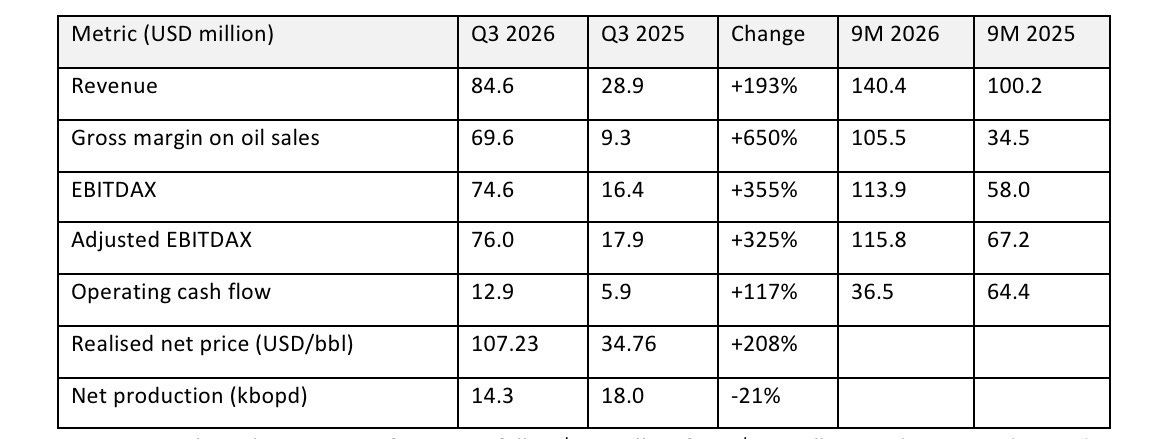
Costs went the right way too. Lifting costs fell to $7.5 million from $9.4 million, and 9M G&A dropped to $5.5 million from $8.1 million.
Nine months of 2026 already exceed the whole of 9M 2025 on revenue, gross margin and EBITDAX. That is despite Q2, when production was almost entirely shut in (0.7 kbopd net) after the regional security situation closed the fields in March.
What we called, and what came in
Every near-term call in the original post held up.
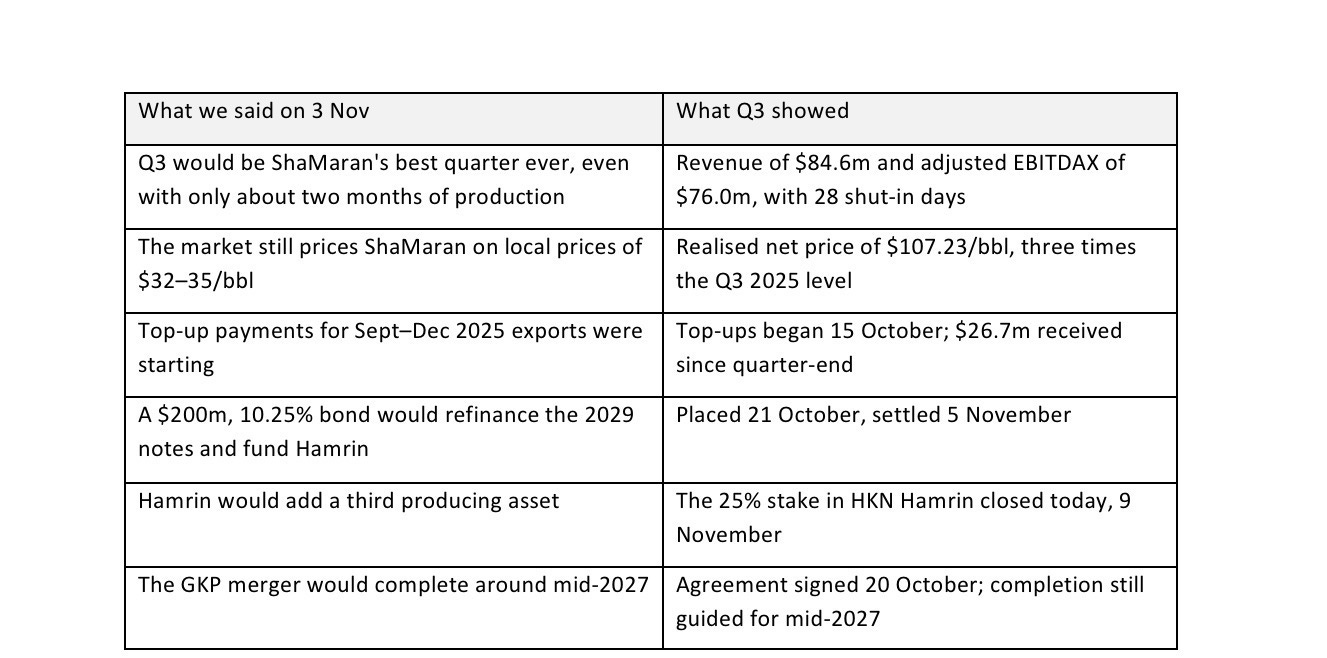
The one thing the market might misread is operating cash flow, which brings us to the next section.
Why operating cash flow looks soft
Q3 operating cash flow was only $12.9 million against $76.0 million of adjusted EBITDAX. That gap is timing, not quality.
• Late restart. Atrush and Sarsang only came back in mid-August. Barrels lifted in late August and September are paid roughly 30 days after each SOMO cargo, so much of Q3’s revenue lands in Q4.
• Top-ups started after quarter-end. The catch-up payments for September–December 2025 exports only began on 15 October.
• The cash is already arriving. $26.7 million came in between 30 September and today, more than double the whole Q3 operating cash flow.
Management says it expects operating cash flow to rise significantly in the coming quarters. Q4 should be the first quarter where reported cash flow catches up with EBITDAX.
Balance sheet, the new bond and Hamrin
Net debt is about $131 million after the refinancing, against a business that just printed $76 million of adjusted EBITDAX in one interrupted quarter.
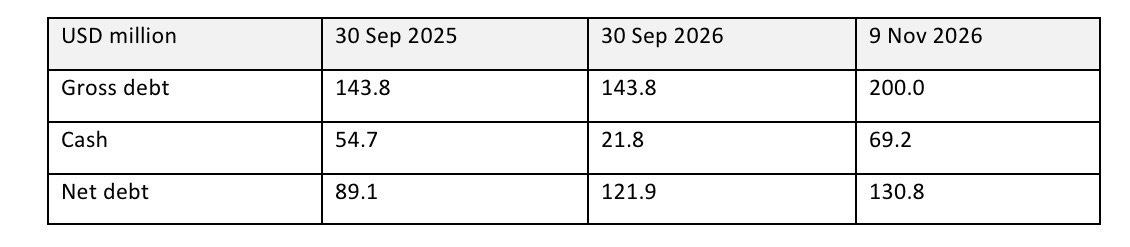
• The bond. The new $200 million senior unsecured bond due 2031 carries a 10.25% coupon, replacing the 12.0% 2029 notes. ShaMaran borrows more, at a lower rate and with two extra years of runway, and the proceeds fund Hamrin.
• Hamrin closed today. ShaMaran now owns 25% of HKN Hamrin Ltd., which holds 100% of the Hamrin development and production contract in Federal Iraq. This is the 500 million to 1 billion barrel field we covered in detail last week.
• Security spending. Drone detection systems will be installed on both the Atrush and Sarsang blocks, a direct response to this year’s shut-ins.
What the run-rate says about valuation
On simple run-rate maths, ShaMaran trades at roughly 2–3x EBITDAX, which keeps the deep-value case from the original post intact.
Two things distort Q3 in opposite directions. The 28 shut-in days understate it, while the $107/bbl realised price overstates it. So I look at it two ways. These are my own back-of-envelope estimates, not company guidance.
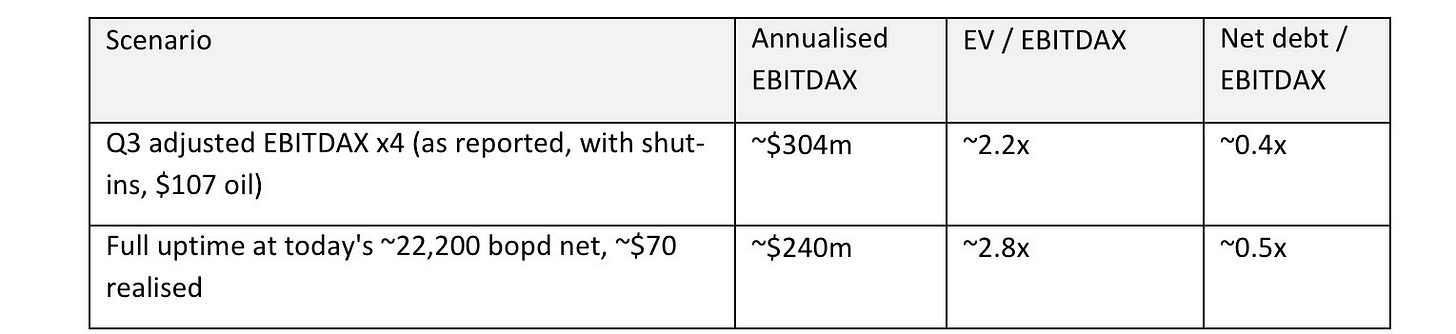
EV of about $670 million uses the ~$540 million equity value from the original post (at a GKP price of 201.75p) plus today’s $131 million net debt. Since the original post the market values decreased slightly, so the multiples are currently even more compelling than in the above table. The $70 case scales Q3 entitlement barrels to current production and reprices them, so treat it as a rough guide.
The new bond adds roughly $20 million a year of interest, and Hamrin will absorb capital. Even so, our stand-alone estimate of about $200 million of 2027 FCF at $65 oil looks reasonable. European peers still trade at 10–15x next-year FCF.
Risks and what to watch
The risks have not changed, and Q3 showed the biggest one in action.
• Security. The fields were shut in from March to mid-August, and Q3 still lost 28 days. Drone detection should help, but further disruption is the main risk to the numbers.
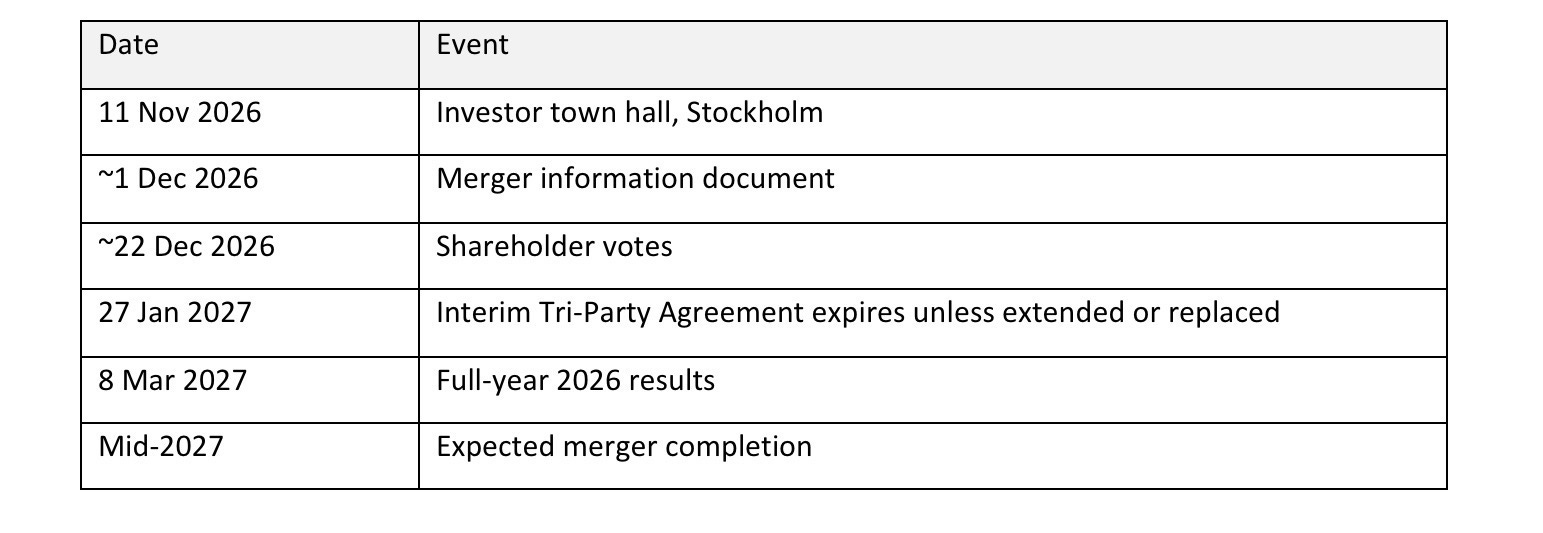
• Payment framework. Exports run under the interim Tri-Party Agreement, now extended only to 27 January 2027. A long-term deal waits on a consultant’s reconciliation of IOC invoices with the PSCs.
• Collecting the top-ups. Payments have started, but IOCs are still working with SOMO to collect the rest.
• Sarsang ramp. Sarsang is at about 12,000 bopd gross, against 18,200 a year ago. More gains depend on facility upgrades and bringing stranded wells back.
• Merger timing. Kurdistan approvals could take six to nine months.
Calendar
Conclusion
Q3 is the proof point the original thesis needed. On export pricing, ShaMaran earns about three times per barrel what it earned on local sales. One interrupted quarter produced $76 million of adjusted EBITDAX, and the cash from it is now arriving.
The refinancing is done, Hamrin is closed, and the merger timetable is unchanged. What remains is execution: keeping the fields running, getting a long-term payment deal in place, and delivering the Gulf Keystone merger. I remain positive on both the near-term trade and the longer-term combined company, and I hold shares in ShaMaran.
This is not investment advice. Figures come from ShaMaran’s Q3 2026 release and my own estimates. Do your own research before investing.
Sources
• ShaMaran Q3 2026 results release (9 Nov 2026)
• Original post on this Substack (3 Nov 2026)
We are moving to Substack. Follow us there!

