R&S Group: Doubling Power Transformer Capacity, Payback 18 Months
What I learned from the Capital Markets Day in Łódź, and why the stock still trades at a discount
R&S Group (SIX: RSGN) held its Capital Markets Day on 4 November in Łódź, Poland, the same day it opened its new power transformer plant there. I came away more confident. Management is delivering, the targets are intact, and the shares still trade well below where the business should be valued.
Berenberg published its takeaways on 6 November. They kept their Buy rating and their CHF 29 price target, about 47% above the current CHF 19.75. Here is my summary of the day and of their research.
The transformer market: a supercycle, not a cycle
Management’s core message: the transformer industry has entered a different demand environment.
· Backlogs have tripled. Before 2020, industry order books covered about one year of production. Today they cover two to three years. Demand is running well ahead of manufacturing capacity, which means longer lead times and stronger pricing.
· Old grids need replacing. By 2030, about half of Europe’s electricity grid will be more than 40 years old.
· Five drivers. Rising electricity use, decarbonisation, decentralised power generation, digitalisation and grid modernisation. R&S expects the global market to grow 4–6% a year. Berenberg thinks it could grow faster to 2030.
· New customers. R&S has mainly sold to European utilities. It is now targeting renewables (over 500 GW of new capacity expected in Europe by 2030), battery storage (BESS) and data centres (a global pipeline of about 845 GW by 2033, about 112 GW of it in Europe). These customers need larger, more complex and higher-margin transformers.
Łódź: the highlight of the day
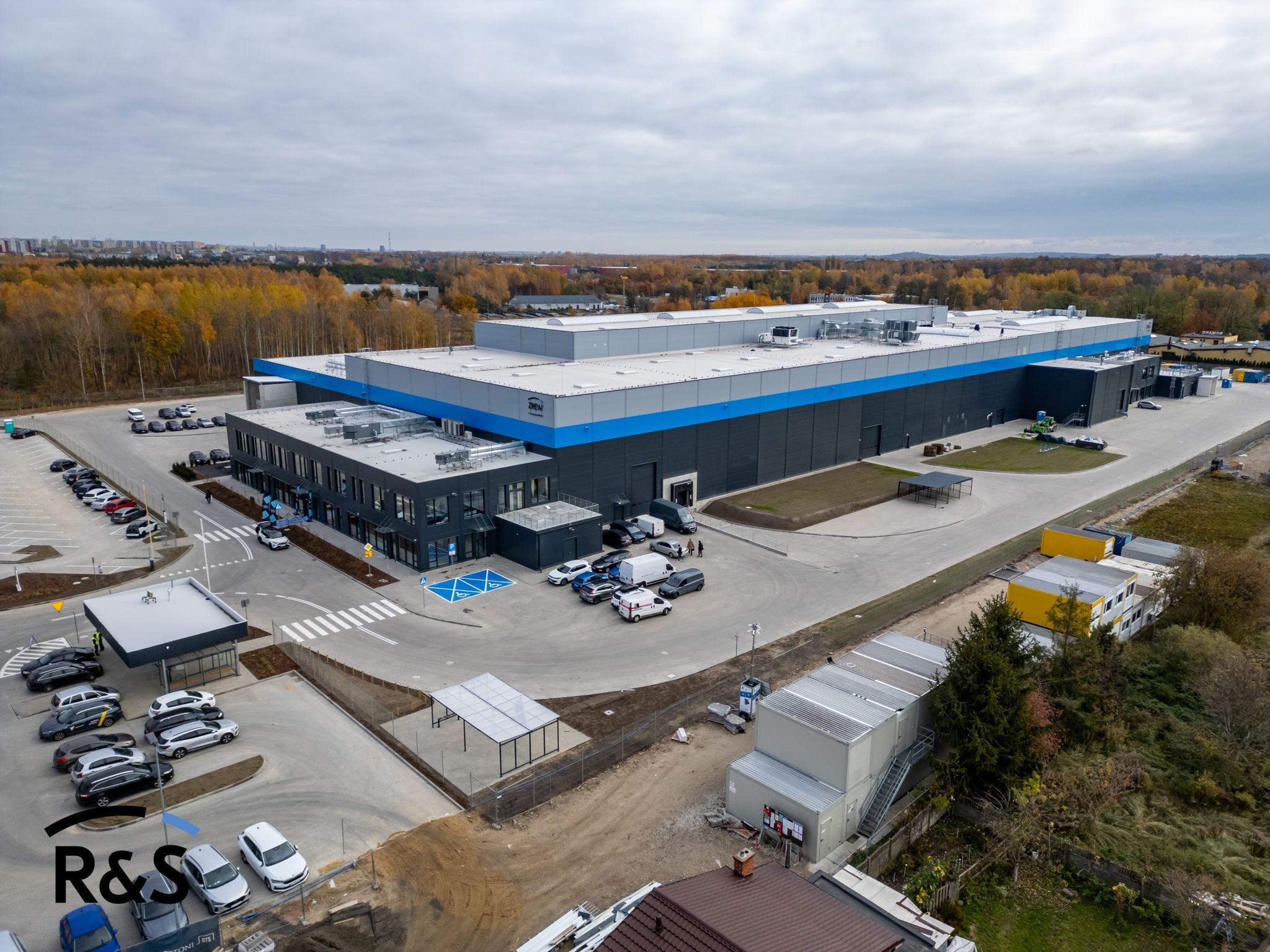
The new plant was the star of the event, with about 200 customers at the opening.
· Fast delivery. The building contract was signed in April 2025, and production started at the end of October 2026: 18 months from contract to first output.
· Capacity doubled. The existing F1 plant makes about 80 power transformers a year. Łódź adds another 80, with room for a further 80 later.
· Bigger products. The plant can build transformers up to 160 MVA and 220 kV, opening up larger and more complex projects.
· Excellent return. Total investment is CHF 29 million, including CHF 10 million of tax relief. Management expects payback in under 18 months. The building is leased, so little capital is tied up in property.
· Already sold. About 80% of planned 2027 capacity is booked. Output ramps up through 2027 to double the previous level in 2028.
Why it matters: power transformers should rise from 20–25% of group sales to over 30%. Berenberg estimates they earn margins at least 5 percentage points higher than distribution transformers, so the mix shift should lift group profitability.
Kyte Powertech: the second lever
The second initiative is Kyte Powertech in Ireland, acquired in August 2024. The Modernization & Repositioning program (MoRe) will move Kyte from mainly utility distribution transformers to larger oil-filled units for BESS, solar and data centers.
· Investment: CHF 10–15 million in 2027–28 for new machinery, automation and more capacity.
· Savings: a 10% cut in the cost base, about CHF 10–12 million a year according to Berenberg’s CMD discussions, fully visible from mid-2028.
· Already moving: Kyte is profitable at the net income level, already supplies UK battery storage projects and is working through US UL certification.
Berenberg argues R&S should not build a US plant, because competitors have already added a lot of capacity there. I agree. Exporting to selected US customers from Europe is the better risk-adjusted route.
Backlog, guidance and capex
· Record backlog: CHF 380 million at the end of September 2026, about 60% of it power transformers. Management expects it to keep growing. Customer down payments help fund the working capital of the expansion.
· 2026 guidance confirmed: sales of CHF 410–420 million, depending on the timing of large power transformer deliveries.
· Medium-term targets confirmed: 8–12% organic sales growth a year and a 19–21% EBITDA margin over a rolling three-year cycle. After a difficult year for the company’s communications, this confirmation is a relief.
· Capex falls sharply: from about 7.5% of sales in 2026 to about 3.5% from 2027. A group-wide SAP system will cost about 1% of sales a year in 2027–29.
· Moderate debt: net debt is expected at about 1.0x EBITDA at the end of 2026, leaving room for acquisitions or higher dividends.
The numbers
2026 is a transition year. Berenberg expects EBIT to fall to CHF 69 million from CHF 79 million in 2025, as the ramp-up costs come through. Growth returns from 2027:
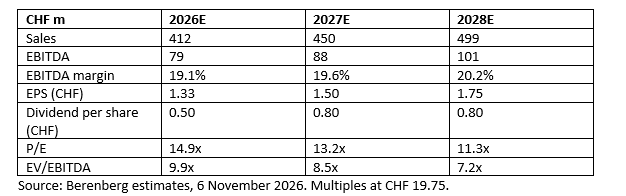
Free cash flow should rise from about CHF 27 million in 2026 to CHF 50 million in 2028 as capex normalises, and the dividend should increase 60% in 2027.
Why the discount?
At CHF 19.75, R&S has a market value of about CHF 735 million and trades at a 26% discount to its peer group, according to Berenberg. The shares are down from a 52-week high of CHF 28.56.
The reasons are not about the business. They are about trust: repeated communication problems and the recent departure of the CEO. Berenberg itself cut its target from CHF 39 to CHF 29 over the summer.
This CMD was the right answer to that. Management showed it can execute: a plant built in 18 months, paying back in under 18 months, and 80% of next year’s capacity already sold.
Risks
· Credibility: after the communication issues and the CEO change, the company has to keep delivering.
· Execution: the Łódź ramp-up must go smoothly, and large power transformer deliveries can slip between quarters.
· Overcapacity: the whole industry is adding capacity. In a few years that could pressure prices, especially in distribution transformers.
· Kyte: the benefits of the restructuring arrive only from 2028.
My view
R&S is one of the cleanest ways to play the European grid build-out. It is doubling its most profitable business with a plant that pays for itself in 18 months, the order book has never been bigger, and capex is about to fall sharply, which should release cash for shareholders.
The stock trades at 8.5x 2027 EBITDA and at a 26% discount to peers because the market lost trust in management. The Łódź opening is the first proof point that this discount is not deserved. As the new capacity comes through in 2027–28, I expect the numbers to close the gap.
Disclosure: RSGN is one of our core positions in the electrification scheme.
follow us on Substack:
https://fitinvestmentideasnewideas.substack.com/p/r-and-s-group-doubling-power-transformer?r=397th

