The Catalyst Arrived Last Week; the Re-Rating Hasn’t. Under 3x Normalized FCF After the Hard Part Is Done – Full Oil Prices, Top-Up Payments Started, Share Price Still Asleep
ShaMaran: The Catalyst Has Arrived, the Re-Rating Hasn’t. Up to 120% Upside
ShaMaran Petroleum has just delivered the catalyst I wrote about a year ago. On October 15, ShaMaran announced that SOMO, Iraq’s state oil marketer, has allocated an additional cargo of oil to the international oil companies in Kurdistan. The extra barrels compensate the companies at full international prices and start paying the top-up receivables for export sales made between September and December 2025.
In plain words: Baghdad is now paying what it promised. The share price barely moved.
When the Iraq-Turkey pipeline reopened in September 2025, I argued the market didn’t understand the deal. The structure was complex: an interim payment first, a top-up later, and full market prices only after a consultant’s review. Many investors expected the price to double on day one and lost patience when it did not. Then 2026 brought the Iran war, and nobody wanted to own a Kurdistan producer.
My take: the hard part is done. The payment mechanism works, money is flowing, and the share price hasn’t caught up.
Introduction to ShaMaran Petroleum
ShaMaran Petroleum Ltd. (Oslo: SNM, Stockholm: SNM) is an independent oil company producing from two adjacent blocks in the Kurdistan Region of Iraq. It is part of the Lundin Group. The Lundin family is the largest shareholder, with around 25%, and also the largest bondholder.
In 2026, ShaMaran moved its corporate home from Canada to Bermuda and its primary listing from the TSX Venture Exchange to Euronext Growth Oslo. Management says the aim is to streamline future capital returns.
The Lundin family provides significant support. William Lundin, who sits on the board, bought shares in December 2024.
ShaMaran holds a 50% working interest in the Atrush Block and 18% in the Sarsang Block. Both are operated by HKN, the Ross Perot, Jr. company, which has strong ties to Kurdistan and to the Trump Administration. In 2025, ShaMaran’s net production averaged 20,900 barrels per day.
At around SEK 1.70 per share, ShaMaran’s market capitalisation is about $540 million. Net debt was $119 million as of August 5, 2026: the $143.8 million ShaMaran bond less $25 million of cash.
What did the 2025 deal promise?
The Iraq-Turkey pipeline closed in 2023 over a dispute between the Kurdistan Regional Government and Baghdad about who collects Kurdistan’s oil revenues. Under the September 2025 agreement, Kurdistan handed its oil revenues to Baghdad in exchange for its share of the federal budget.
The two sides do not trust each other, so they agreed an interim mechanism:
• The oil companies receive an initial payment of $16 per barrel, less a $2 transportation fee.
• An international consultant reconciles the companies’ invoices against their production sharing contracts.
• Once the review is complete, the companies receive top-up payments that bring them to their full contract entitlement at international prices.
Before the reopening, ShaMaran sold oil to local traders at $32–35 per barrel, and the Kurdistan government took about half. The promise was that ShaMaran would receive the full Brent-linked price, adjusted for quality and transport, roughly doubling its net price per barrel.
What has happened since?
• September 27, 2025: exports through the Iraq-Turkey pipeline restart.
• November 2025: ShaMaran’s first cargo is lifted from the Ceyhan terminal.
• Since then: payments have arrived about 30 days after each lifting, with no payment delays from SOMO, according to the company.
• Q2 2026: ShaMaran’s net realized oil price was $84.23 per barrel, up from $33.12 a year earlier. That is the international price, and it is exactly what the market doubted.
• The consultant’s review was extended several times, to March, June and finally September 2026. Management has since confirmed it is complete.
• October 15, 2026: SOMO allocates an extra cargo to start paying the top-ups on September–December 2025 sales.
The catalyst has happened. ShaMaran sells its oil at international prices, and Baghdad has started to pay the arrears.
The release does not give the amount. By my rough estimate, assuming about 20,000 net barrels per day over roughly three months and a top-up of about $16 per barrel, ShaMaran is owed in the region of $30 million. That is around a quarter of its net debt.
Why hasn’t the share price re-rated?
I see three reasons.
1. The Iran war buried the good news. After the Strait of Hormuz blockade began on February 28, ShaMaran shut in both blocks as a precaution on March 2. Sarsang was hit by drones on March 5 and April 1. Production restarted in late June, and Atrush quickly reached over 40,000 barrels per day, but operations were suspended again on July 20. ShaMaran’s net production fell from 22,700 barrels per day in Q2 2025 to 700 in Q2 2026.
2. The top-up announcement came without numbers. It says neither how much ShaMaran will receive nor when the rest will be paid. Investors do not pay for numbers they cannot model.
3. The capital returns have not arrived yet. A year ago, I expected ShaMaran to be net cash by mid-2026 and to start dividends or buybacks this year. The shut-ins postponed that. Net debt rose from $102 million at the end of 2025 to $119 million in August.
None of these changes the asset’s economics. They change the timing.
Where is production now?
ShaMaran’s last company update, in August, said both blocks were shut in with no certainty about how long. On August 30, Kurdistan’s natural resources minister said that all the region’s oilfields except Sarsang had restarted. ShaMaran has not published an operational update since. Sarsang’s return to full capacity depends on the damage assessment and on long-lead repair parts.
Atrush matters most. ShaMaran owns 50% of it, and its capacity has been debottlenecked to 40,000 barrels per day. At that rate, Atrush alone gives ShaMaran about 20,000 net barrels per day, roughly its full 2025 net production even without Sarsang.
What will the impact be on ShaMaran’s FCF?
ShaMaran is a very lean producer. Lifting costs are $3–5 per barrel, and maintenance capex is about $2 per barrel.
At around 20,000 net barrels per day and full international prices, I estimate normalized FCF at about $200 million a year with Brent in the low $70s, and more at higher oil prices. The top-up payments for September–December 2025 come on top of that.
What the market needs now is two or three clean quarters of production at international prices. Once it sees them, the FCF will show up in the reported numbers and will be hard to ignore.
What are the risks?
The risk profile has changed. A year ago, the main risk was that Baghdad would not pay. That risk has fallen: payments have run on time for a year, and the top-ups have started.
The main risk now is security. The Iran war showed that Kurdistan fields can be shut in for months and hit by drones. A renewed escalation would stop production again.
The US troops exited Iraq and Kurdistan by September 30th this year, so there is less reason for the drone attacks in Erbil by Iran and the Iraqi militia supported by Iran.
IOCs in Kurdistan have installed drone-detection radars to operate without putting field personnel at risk.
Other risks:
• The size and timing of the remaining top-up payments have not been disclosed.
• The interim arrangements still need to become a long-term agreement. The Iraq-Turkey pipeline agreement has been extended to July 2027.
• Net debt of $119 million is manageable, but it is higher than a year ago.
• The deal has the support of the Iraqi parliament and the US Government, but this remains a politically unstable region.
What is the valuation impact?
One year before the pipeline reopened, ShaMaran traded at 4x FCF. Today, at about $540 million, it trades below 3x my estimate of normalized FCF.
Historically, Kurdistan producers traded at a discount because investors feared Baghdad would never recognize their contracts. Baghdad has now gone further than recognizing them: it is paying full international prices and settling arrears. That discount should narrow.
If ShaMaran re-rates to 4x normalized FCF, the upside is close to 50%. At 6x, it is over 120%.
FCF
P/FCF
Mkt cap
Share price
$ million
$ million
SEK
Before reopening (Sept 2025)
100
4
400
1.3
Today (normalized FCF)
200
2.7
540
1.7
Re-rate
200
4
800
2.5
Re-rate
200
5
1000
3.2
Re-rate
200
6
1200
3.8
2026
200
6
1200
3.8
Source: author’s calculations. Normalized FCF assumes about 20,000 net barrels per day at international prices and Brent in the low $70s.
Conclusion
The catalyst I wrote about has happened. ShaMaran sells its oil at international prices, Baghdad pays on time, and the top-up payments have started. The share price does not reflect that yet, because the Iran war and the shut-ins pushed the cash flows back.
I see this as a timing problem, not a broken thesis. Once production stabilizes and the top-up amounts become visible, I expect the market to value ShaMaran on its normalized FCF. Buybacks or dividends should follow, and the move to Oslo and Bermuda was made with exactly that in mind.
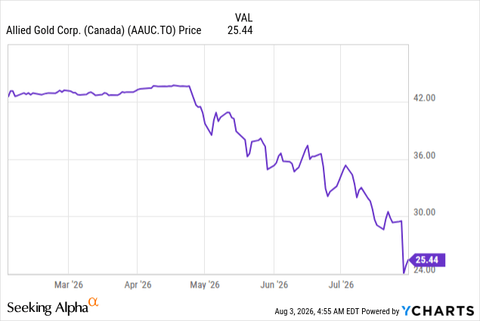
Allied Gold (AAUC) is Africa’s fastest-growing gold producer. The takeover that was supposed to close this year collapsed in July, the stock fell roughly 45% from the bid price, and what’s left is a business generating serious cash at a valuation that doesn’t reflect it.
The production ramp is the story:
2025: 379 koz
2026 guidance: 485–575 koz — 40% growth at midpoint
2027 guidance: 640–680 koz — 75% above 2025 at midpoint
Three countries: Mali, Ethiopia, Côte d’Ivoire.
What happened
In January, Zijin Gold bid C$44 per share in cash. That was roughly a 5% premium to the undisturbed price of C$41.50 — thin, and worth remembering.
Shareholders approved in April. Then things started going difficult.
The problem surfaced on 29 May. Rather than closing, the companies announced a two-month extension — and the Financial Times reported why: China’s National Development and Reform Commission had not cleared the deal. Canadian and West African regulators had already signed off. Beijing was the only holdout.
From there the stock bled steadily. The market was pricing a rising probability that the deal died, and it was right to.
On 29 July the two sides let the deadline expire, agreeing there was no reasonable likelihood the remaining conditions would be met. Allied fell 18% that morning to C$24.27, valuing the company at just over C$3bn. No break fee either way, as the breakup was due to regulatory issues.
Zijin announced it bought 12.8m newly issued shares at C$32.55 — a 10% premium to the 30-day VWAP — taking a 9.2% stake for US$295m.
That last point deserves emphasis. The acquirer who just walked away chose to buy in at a price well above where the stock trades today. Zijin didn’t lose conviction in the asset. It lost an argument with its own regulator.
The numbers
Key ratios
2024
2025
2026E
2027E
Market cap (US$m)
1,519.9
2,276.1
2,512.9
2,512.9
EV (US$m)
1,391.2
1,950.6
1,831.6
666.9
EBITDA (US$m)
211.1
457.5
1,251.5
1,627.4
Net cash / (debt) (US$m)
128.6
325.5
681.3
1,846.0
Free cash flow (US$m)
−83.9
81.9
225.3
1,164.7
EBITDA margin
32%
40%
63%
66%
EV/EBITDA
6.6x
4.3x
1.5x
0.4x
P/E
−68.1x
922.3x
4.0x
2.7x
FCF per share (US$)
−0.3
0.7
1.7
8.6
ROCE
2%
23%
49%
44%
Net debt/EBITDA
−0.6x
−0.7x
−0.5x
−1.1x
Source: Hannam Partners
The table shows that Allied trades at 1.5x and 0.4x EV/EBITDA for 2026 and 2027, respectively.
The margin expansion from 32% to 66% is Kurmuk doing the work.
Comparable African producers trade at 5–7x EV/EBITDA. Hannam raised its target to C$49 from C$44 after the deal broke — a clear statement that they thought Zijin was getting it cheap. Canaccord sits at C$40.
Why I trust the operator
Peter Marrone founded Yamana Gold in 2003 and ran it for twenty years, building it from a single asset into a million-ounce producer before selling to Agnico Eagle and Pan American Silver for US$4.8bn in 2023.
He put the proceeds into Allied the same year and brought most of the Yamana team with him.
They have done this before. That is not a small thing in a sector where execution is everything.
The risks
Mali. There is an active Islamist insurgency. The fighting is on the other side of the country from Allied’s operations, and Mali has rarely been calm — but it is a real risk, not a footnote, and Beijing’s own regulator cited it as a reason to balk. Allied was first to sign revised terms with the government in 2023 and got better terms than peers. Mali is about a third of NAV today, and that share falls as the other mines ramp.
Gold price. Everything above rests on realised prices near US$4,380/oz holding. At materially lower gold, the 66% margin and the US$1.16bn of 2027 free cash flow compress fast. This is a leveraged bet on the gold price whether or not you want it to be.
Conversion. Guidance is guidance. The 2027 number requires Kurmuk to land roughly on schedule and the other assets to hold. The risk is low, as the company on yesterday’s Q2 call confirmed that production is on schedule to commence in August.
The Q2 call
Allied reported on 5 August and held the call the following morning.
Operating numbers were pre-announced: 97,429 oz in Q2, 193,445 oz for the half, in line with guidance. AISC below US$2,200/oz against a realized gold price of roughly US$4,380/oz. That spread is what drives the whole table above.
Cash stood at approximately US$190m at 30 June, after Kurmuk growth capex, taxes and working capital. The US$295m from Zijin sits on top of that.
Kurmuk is on budget and on schedule, with operations starting this month and first gold a few weeks later. It is targeted at 240,000–270,000 oz in 2027 and around 300,000 oz in 2028 at industry-leading costs. That one asset is most of the growth.
Management was clear that the strategy hasn’t changed because the bid went away. Full-year guidance reconfirmed, growth initiatives reconfirmed mine by mine.
The open question is what happens to the cash. By end-2027 the balance approaches the entire current market capitalisation. That forces a choice: buy back stock at these levels, pay it out, or acquire. The answer matters more than any single quarter’s production figure.
Position
We have been buying since the termination was announced. Stock is up every day.
The deal collapse removed a bid, not a business. What is left is a growing producer at 1.5x this year’s EBITDA, generating free cash flow that approaches its own market cap within two years, run by a team that has built and sold a major gold company before.
I think the stock recovers. The timing depends on gold holding and on Mali staying quiet.
The Tungsten Play That Could Follow the MP Materials Playbook
Metric
Value
Current Price
~GBp 258 (London) | ~$13.50 ADS (NYSE American)
Market Cap
~£508m / ~$670m
Rating
**BULLISH
Second-Largest Shareholder
**Stanley Druckenmiller
Government Status
The only tungsten company in the world with US DPA Title III funding
Key Catalyst (imminent)
US Government decision on funding of DFS — could arrive before June 2026 PFS completion
Pilot Mountain spot EBITDA
Bernberg estimates $350–400m pa at Tungsten prices of (~$2,445/MTU)
Base-case combined NPV (5%)
$890m (~$800/MTU) vs $670m market cap
Spot combined NPV (5%)
~$4.9bn vs $670m market cap (+638%) at Tungsten prices of (~$2,445/MTU)
Commercial production target
Q3–Q4 2028
Investment Thesis
Guardian Metal Resources is the only dual-listed pure-play tungsten developer with projects on US soil, and the only tungsten company in the world to have received US government funding. It holds a confirmed $6.2m Department of War DPA Title III award, is likely seeking a materially higher second tranche for its Definitive Feasibility Study given the PFS is almost complete, and is in live discussions with both the Defense Logistics Agency — which is preparing a tungsten tender, with its stockpile facility just 35 miles from Pilot Mountain — and the Project Vault programme (direct contracts with Lockheed Martin, Raytheon and other prime defence contractors). Stanley Druckenmiller is the second-largest shareholder.
Tungsten prices have hit record highs (~$3,140/MTU APT as of 22 May 2026, up from ~$320/MTU in 2022) driven by Chinese export controls, a January 2027 US defence procurement ban on Chinese-origin tungsten, and surging NATO rearmament demand. The two Nevada projects — Pilot Mountain and Tempiute — have the combined capacity to cover ~100% of US direct defence demand. At current spot prices, Pilot Mountain alone would generate $350–400m of annual EBITDA (Berenberg estimate based on ~$2,450/MTU) against a total company market cap of $670m. The key re-rating Catalyst is the potential for a much larger government funding package — potentially modelled on the DoW deal with MP Materials (NYSE: MP) in July 2025, which tripled that company’s share price. GMET, with its most important catalysts still ahead, offers asymmetric upside to that same playbook.
Part One: Tungsten — The Most Irreplaceable Metal You’ve Never Heard Of
Why Tungsten Matters
Tungsten is not a headline metal. It is rarely discussed in the same breath as lithium, cobalt, or rare earths. That is beginning to change — fast.
Tungsten has properties that make it functionally irreplaceable. It holds the highest melting point of any element (3,422°C), the highest boiling point (5,930°C), the highest tensile strength of any pure metal at temperatures above 1,650°C, the lowest coefficient of linear thermal expansion of all metals, and a density of 19.2 t/m³. The broadest use is industrial — tungsten carbide rods and tips in mining equipment, drill bits, cutting tools, and road-milling machines dominate volume. But it is the defence applications that have captured Washington’s attention: tungsten heavy alloy is the material of choice for kinetic energy penetrators (tank-busting rounds), armour-piercing ammunition, missile components, rocket nozzles, and radiation shielding. In December 2024, NATO designated tungsten as one of just 12 defence-critical raw materials, citing high supply risk across fighter aircraft, main battle tanks, missiles, submarines, and corvettes. The global tungsten market is worth ~$5bn pa — but the industries that depend on it are orders of magnitude larger.
Tungsten First-Use by Material (2025)
Material
Share
Tungsten carbide (cemented carbides)
~65%
Steels & superalloys (incl. jet turbine blades)
~14%
Tungsten metal products (ammunition, shielding)
~12%
Chemicals & catalysts
~9%
Tungsten End-Use by Industry (2025)
Industry
Share
Transport (automotive tooling)
~26%
Mining & construction (drill bits, road milling)
~26%
Industrial use
~14%
Chemical/petrochemical
~10%
Consumer durables
~9%
**Defence (fastest growing segment)
**~8%
Energy
~6%
Medical/pharmaceutical
~1%
The China Problem
China produces ~82% of the global tungsten mine supply. Russia and North Korea are among the other notable producers outside the Western world, making the geopolitical risk concentration acutely dangerous for the US defence supply chain. China accounts for only ~36% of global consumption, meaning the rest of the world is structurally dependent on Chinese exports.
Country
Share of Global Production
China
82%
Vietnam
4%
Russia
2%
North Korea
2%
Bolivia
2%
All others
8%
Key developments that have broken the status quo:
February 2025: February 2025: China introduced export licensing on tungsten, citing national security. APT exports essentially ceased for several months.
Prices: European APT rose from ~$331/MTU to (~$3,140/MTU in 14 months — a 600%+ increase to record highs.
Supply: The US has had no commercial tungsten mining since 2015. For defence-grade products, US external dependence is effectively 100%.
Policy: January 2027: DFARS Rule 252.225-7052 bans US military procurement of tungsten from China, Russia, North Korea, or Iran. Hard statutory deadline.
APT Price History and Outlook
Period
APT Price (USD/MTU)
FY2022A
~322
FY2023A
~326
FY2024A
~320
FY2025A
~359 → spike to ~1,230
FY2026E (Berenberg)
~1,750
FY2027E (Berenberg)
~1,350
FY2028E (Berenberg)
~1,000
**Spot (22 May 2026)
**~3,140
Part Two: The MP Materials Playbook — and Why Tungsten Might Be Next
What MP Materials Proved
MP Materials (NYSE: MP) is the operator of Mountain Pass in California. Despite its strategic importance, the stock spent years around $15–30 as a commodity miner with a Chinese offtake partner (Shenghe Resources). Critically, MP received its first government funding — around $4m — from the exact same DPA Title III Office that has now funded Guardian Metal’s initial $6.2m award. The pattern that followed is the template Guardian is now tracking:
MP Step 1: ~$4m initial DPA Title III grant (same office as Guardian’s $6.2m).
MP Step 2: ~$9.6m second DPA Title III grant
MP Step 3:~$35m DoD contract
MP Step 4: Then: $400m DoD preferred equity investment (15% stake), $150m loan, 10-year price floor at $110/kg NdPr, 10-year offtake, termination of Chinese offtake.
MP Result: Stock +50% on day one. +224% for the full year 2025. Market cap added ~$6–7bn
Perpetual Resources received a first grant of $6m from the same DPA Title III Office, and subsequently received a $1 billion loan. The pattern is consistent: a small initial grant establishes recipient status, followed by transformational follow-on capital.
Government Investment Comparison
Company
Mineral
Initial Grant
Follow-on
Stock Reaction
MP Materials
Rare Earths
~$4m (DPA Title III)
$400m equity + $150m loan
+50% day 1, +224% full year
Perpetual Resources
Critical Minerals
~$6m (DPA Title III)
~$1bn loan
Material re-rating
Trilogy Metals (TMQ)
Copper/Cobalt
—
$35.6m DoD equity (10%).
+211% day 1, +402% 2 weeks
Lithium Americas (LAC)
Lithium
$2.26bn DOE loan
5% equity conversion
+21.5% on equity stake
**Guardian Metal (GMET)
**Tungsten
**$6.2m (DPA Title III)
Step 2 DFS funding sought
+405% in 2025 — pre follow-on
* Step 2 funding for MP Materials was 150% of the Step 1 funding. We would expect at least similar increase
Why Tungsten Is the Next Priority
Statutory deadline. The January 2027 DFARS ban creates a hard supply cliff for US defence. Unlike rare earths, tungsten has no substitutes in defence applications and no time to wait.
Domestic supply is zero. The US has not commercially mined tungsten since 2015. Guardian Metal is the most advanced US-based tungsten developer and the only tungsten company in the world to have received US government funding.
DLA tender is imminent. The Defence Logistics Agency is preparing a tungsten procurement tender. Guardian is likely in discussions with DLA, and it can be expected that the Guardian will bid. The DLA proposed stockpile facility is 35 miles from Pilot Mountain — an advantage no competitor can match
Project Vault. Guardian is in discussions with the Project Vault programme, through which it could sign direct supply contracts with Lockheed Martin, Raytheon, and other prime defence contractors.
Price signal. At (~$3,140/MTU , every month of delay adds to US strategic vulnerability.
Part Three: The MP Materials Valuation Story — What Government Backing Does to a Mining Stock
Before the Deal: Four Years Going Nowhere
MP closed the last trading day of 2024 at $15.60 — virtually unchanged from its $15 SPAC IPO price in November 2020. Four years of flat returns despite strategic national importance. The market had no framework to price in the strategic premium without a concrete government commitment.
July 10, 2025: The Day Everything Changed
The $400m equity investment converted DoW into MP’s largest shareholder — not a grant or loan, but the US government putting real money at risk alongside private shareholders. This alone changed how institutional allocators with defence, ESG, or thematic mandates could justify owning the stock.
The 10-year price floor at $110/kg was the single most transformative element. A government-backed price floor on a 10-year horizon converts commodity-exposed revenue into something closer to a contracted utility income stream. Markets re-rate such businesses at dramatically higher multiples — similar to a power purchase agreement for a renewable energy company.
The termination of the Shenghe offtake removed the single biggest bear argument overnight. MP was no longer a company whose strategic output flowed to China.
Crowding-in of private capital: the DoW deal unlocked $1bn in commercial bank financing from JPMorgan Chase and Goldman Sachs. Government validation lowered the risk premium that private lenders require — a virtuous cycle that substantially reduced MP’s cost of capital.
MP Materials Share Price Timeline
Date / Period
Price (approx.)
Notes
End of 2024
~$15.60
Essentially flat from 2020 IPO — four years of nothing
July 9, 2025 (pre-deal)
~$30
Moving in anticipation
July 10, 2025 (DoD deal day)
~$46
**+50% in a single session
July 15, 2025 (Apple deal)
~$55
Apple’s $500m partnership announced; further +20%
October 14, 2025 (peak)
~$100.25
+235% from pre-deal price
End of 2025
~$52–55
+224% for the full year
Market cap added
~$6–7bn
vs ~$3bn pre-deal
Five days after the DoW deal, Apple announced a $500m, four-year partnership with MP to produce recycled rare earth magnets in the US. The stock added a further ~20%. The lesson: government backing unlocks private-sector demand and changes the entire commercial ecosystem around a company.
Applying the Framework to Guardian Metal
Management has explicitly identified government equity ownership as the “optionality that would create immediate value” — and confirmed that this single step tripled MP Materials’ share price. Guardian is the only tungsten company in the world with government relationships, US soil assets, and current DPA recipient status to replicate that outcome.
Illustrative GMET Re-Rating Scenarios
Scenario
Implied GMET Valuation
Notes
No deal — base case NPV ($725/MTU)
~$890m (+33%)
Berenberg conservative, no deal
No deal — spot NPV (~$2,500/MTU)
~$4.9bn (+638%)
Berenberg spot case, no deal
Small deal (DFS grant ~$25–50m)
~$1.0–1.2bn
Incremental re-rating, financing de-risk
Medium deal ($100m+ equity/loan + price floor)
~$1.5–2.5bn
Meaningful multiple expansion
Full MP-style deal (equity + price floor + offtake)
~$3–5bn+
Full re-rating as contracted strategic platform
The Key Parallel: GMET Today Looks Like MP in 2022
MP was essentially flat for four years after its IPO before the DoW deal re-rated it by 224% in a single year. GMET IPO’d on AIM in May 2023 at GBp 8.5/share and trades at ~GBp 258 today — a ~30x return. But that re-rating reflects exploration milestones and the initial $6.2m grant. The bulk of MP’s value unlock came after the major deal, not before. GMET’s most transformative Catalyst — a full government partnership — is still ahead.
Part Four: The Assets — Two Projects That Could Supply All of America Defense Needs
Pilot Mountain — America’s Tungsten Future
Pilot Mountain is the most advanced domestic US tungsten development project, with serious work beginning over four years ago, giving the Company a clear first-mover advantage in the metal. Located 200km south-east of Reno in Nevada, adjacent to the Hawthorne Army Depot (the world’s largest ammunition depot), it is the subject of a US government-funded PFS due in June 2026. The DLA’s tungsten stockpile facility — which will issue the forthcoming tungsten tender — is just 35 miles away. There is no closer domestic tungsten source for the US defence supply chain. Guardian has signed an LOI with Global Tungsten & Powders for an offtake that would directly support a US strategic tungsten stockpile.
Development Timeline
Milestone
Target
PFS completion
June 2026
Government DFS funding decision
Potentially before June 2026, PFS completion
DFS completion
Q1 2027
Final Investment Decision (FID)
Q2 2027
Equipment deposit payments
During 2026
Construction period
~15 months post-FID
Commercial production
Q3–Q4 2028 (under Trump administration)
Management has confirmed equipment deposit payments will begin in 2026 — a tangible signal of development confidence that precedes formal FID.
Scale of the Opportunity
Metric
Detail
Mill throughput target
4,000 tonnes of processed material per day
Annual tungsten production
1,800–2,000 tonnes per year
US demand coverage
100% of the US annual direct defence demand
US production status
In production, it would be the only tungsten production facility in the US
Deposits on the project
Four total — PFS covers two; two under active exploration (upside not in models) plus other undrilled target areas.
The PFS will additionally incorporate the higher-grade Garnet orebody. Ongoing drilling has returned intercepts of up to 39.3m at 0.735% WO₃. Resource expansion on PFS publication is highly likely. Two further deposits plus are under active exploration and are not included in any current model
The Government Funding Pathway — A Critical Structural Advantage
What sets Pilot Mountain apart from every other tungsten project globally is not just location or geology — it is the existing government funding relationship and the pathway it creates for follow-on capital.
Recipient status: Recipient qualification takes at least two years. Guardian has already completed this process. Any other tungsten developer seeking DPA funding would need to start from scratch and wait at least two years before receiving their first dollar, and that is if the portal is open, which it currently is not. Guardian is the only U.S.-focused tungsten company with this status.
Amendment pathway: Once a company has recipient status, requesting the next tranche can be done simply through an amendment to existing documentation — not a new competitive application, as we have seen with both MP and Perpetua. It is expected that the management would be seeking DFS funding through this mechanism
Scale of ask: It is expected that management would ask for a materially higher number than the initial $6.2m — consistent with the MP Materials and Perpetual Resources precedent.
Timing: A decision on DFS funding can come before the June 2026 PFS completion — meaning investors could see a government funding announcement even before the PFS is published.
DLA tender: The DLA is preparing a tungsten tender. Guardian would be a preferred bidder given they could provide a domestic source within 3 years, which is the typical DLA required delivery timeline. With the DLA stockpile facility 35 miles from Pilot Mountain, Guardian has a decisive logistical advantage.
Project Vault: Project Vault could yield direct contracts with Lockheed Martin, Raytheon, and comparable companies — creating an offtake structure that de-risks revenue before a single tonne is mined.
Tempiute — Near-Term Revenue Optionality
Tempiute is a past-producing mine 237km from Pilot Mountain, last operated by Union Carbide (1977–1984), before operations were halted when China flooded the global tungsten market. Guardian acquired it only one year ago. It has two structural advantages: existing infrastructure and the ability to generate tungsten revenue well before Pilot Mountain reaches commercial production.
~$40m of usable infrastructure on site. Mill buildings with equipment foundations in place, a 3,000kW electrical substation, water infrastructure, and five levels of underground adits over a 2.5km strike length. When China killed the tungsten price, Union Carbide walked away from a functional mine.
Private mining rights = faster permitting. Tempiute sits on private mining rights — no federal permitting required. It can be developed under Nevada state rules, which is materially faster than the federal BLM permitting process governing Pilot Mountain.
The tailings opportunity: When the mine operated for 60 years, processing technology (via gravity) recovered only approximately 50% of the tungsten. The rest remains in the tailings — on the surface, with mining costs of approximately $2/tonne. The plan, if we find sufficient tailings volume, is to build processing on site and do it there. This would establish Guardian as an active tungsten producer and supplier to the US Government before Pilot Mountain reaches commercial production. Separate to the tailings, there is ore stockpiled material which could be shipped to a 3rd party processor at any time.
Tempiute Development Sequence
Phase
Timing
Capex
Output
Ore Stockpiles
2026
Minimal
Establishes Guardian as active producer
On-site tailings reprocessing
2027
Modest
Ongoing tungsten supply from surface material
Full mine reopening
2028+
$80–100m
~2,000 tonnes/year (as in original operation)
Government funding application
Already submitted
N/A
Could accelerate all phases
Combined Portfolio Valuation Scenarios
Tungsten Price Assumption
Combined NPV(5%)
vs Current Mkt Cap (~$670m)
**$725/MTU (base case — Berenberg conservative)
**$890m
**+33%
$1,100/MTU
$1,698m
+153%
$1,500/MTU
$2,626m
+292%
$2,000/MTU
$3,553m
+430%
~$2,500/MTU (at Berenberg research date)
**~$4,944m
**+638%
At base-case conservative pricing — well below current spot — the combined NPV of $890m already exceeds the $670m market cap, before $70m+ cash (post-IPO), before any M&A uplift, and before any government deal premium. At spot prices, the combined NPV approaches $5 billion — roughly 7x the current market cap. And at spot, Pilot Mountain alone generates $350–400m of annual EBITDA against a company market cap of $670m.
Part Five: Catalysts — A Clear and Near-Term List
Imminent (Q2 2026)
Government DFS funding decision (could come before June PFS). it is expected that under the existing DPA III contract that management would be looking for materially more funding under the existing contract to support the project into DFS and construction. This would be the first signal of a materially larger government commitment — the equivalent of the ‘second grant’ that preceded transformational deals at MP Materials and Perpetual Resources.
Pilot Mountain PFS — June 2026. The DoW-funded PFS delivers the first formally audited project economics, a resource update incorporating the Garnet orebody, and a capital cost estimate. PFS publication typically triggers significant re-ratings as estimates become audited facts.
H2 2026
Tempiute maiden resource. With 44 drill holes complete, a maiden resource is targeted for H2 2026. This transitions Tempiute from ‘historic mine with no resource’ to formal asset — effectively doubling the de-risked portfolio in a single announcement.
DLA tender submission. As the DLA’s tungsten procurement tender is issued, Guardian will likely submit with a goal to be the preferred domestic supplier — 35 miles from the stockpile facility. Any contract award or preferred-supplier designation would be highly catalytic.
Tempiute tailings processing commencement. Ore would potentially be shipped this year, and tailings reprocessing, if sufficient volumes are found, would be H2 2027. Shipping ore to third-party processors establishes Guardian as an active tungsten producer and supplier to US defence, enabling it to bid in the DLA tender and begin commercial conversations with prime contractors
2027 and Beyond
DFS completion (Q1 2027) and FID (Q2 2027). These milestones convert Pilot Mountain from development to committed construction — the point at which institutional capital allocators typically significantly increase position sizing.
US government equity investment / price floor / offtake. The deal structure management has explicitly identified as the ‘optionality that would create immediate value’. With DPA recipient status established, the DLA tender in progress, and Project Vault conversations underway, the scaffolding for such a deal is actively being built.
Commercial production Q3–Q4 2028. Under the current timeline, Guardian would be producing tungsten while the Trump administration is still in office — politically advantageous for continued government support.
Part Six: Why Now
Guardian Metal shares have had a remarkable run: +15% in 2023, +201% in 2024, and +405% in 2025. At ~258p (London) / ~$13.50 per ADS (NYSE), the stock sits near its March 2026 NYSE IPO price having consolidated post-listing. This consolidation — at a time when the PFS is weeks away, government DFS funding could in theory arrive before the PFS, the DLA tender is being prepared, and Druckenmiller has built his position — looks like an attractive entry point for investors with appropriate risk tolerance and a 12–24 month horizon.
Druckenmiller’s involvement deserves specific mention. One of the most respected macro investors in the world becoming the second-largest shareholder signals that some of the most sophisticated capital allocators see the same opportunity outlined here. Druckenmiller is not a momentum chaser — his presence suggests deep conviction in the government-backed critical minerals thesis as applied specifically to Guardian Metal.
The company is fully funded for the DFS from the NYSE IPO proceeds (~$68m raised). Any government funding received will serve to accelerate production timelines, not just cover costs. Berenberg initiated at Positive on 31 March 2026 with combined NPV scenarios from $890m (base) to $4.9bn (spot). Given the ~$670m market cap and ~$70m+ cash, the risk/reward appears asymmetric.
Risks
Pre-production stage. Neither project is in production. PFS and DFS estimates may differ from current assumptions. Resource extensions are not guaranteed, and construction projects in mining frequently encounter delays or cost overruns.
Capex uncertainty. Management’s $150–200m Pilot Mountain estimate is higher than Berenberg’s $95m. Until the PFS provides audited figures, this number remains subject to revision.
Permitting. Pilot Mountain requires US Federal and Nevada state environmental permits. The current regulatory environment for critical minerals is constructive, but could change.
Tungsten price volatility. Current prices reflect acute supply tightness. Prices could moderate if Chinese exports resume, new supply arrives faster than expected, or global industrial demand weakens. Berenberg’s base case ($725/MTU) is well below spot — a deliberate conservatism that provides a margin of safety.
Government deal not guaranteed. The MP-style deal (equity, price floors, offtake) has not yet been offered to any tungsten company. The government may use alternative instruments — loans, grants, stockpile purchases — that are less directly value-accretive for equity holders.
Berenberg conflict of interest. Berenberg Capital Markets acted as co-manager on the GMTL NYSE American IPO. Readers should factor this relationship into their assessment of the Berenberg initiation note.
Summary
Guardian Metal Resources occupies a unique and time-sensitive position: the only dual-listed, government-backed US tungsten developer, with two advanced Nevada projects capable of collectively supplying 100% of US direct defense demand — in a world where Chinese tungsten is increasingly unavailable, Russian and North Korean supply is sanctioned, prices are at record highs, and a statutory defence procurement ban takes effect in January 2027.
Stanley Druckenmiller is the second-largest shareholder. The company is the only tungsten recipient of US DPA Title III funding in the world. The Defense Logistics Agency stockpile facility — which is preparing a tungsten tender — is 35 miles from Pilot Mountain. A government DFS funding decision could in theory come before the June 2026 PFS given the existing contract would complete on publication of the PFS. At current spot prices, Pilot Mountain alone would generate $350–400m of annual EBITDA against a total company market cap of $670m.
The MP Materials precedent, and the Perpetual Resources precedent, showed that the DPA Title III Office’s initial small award is not the end of the story — it is the beginning. Once recipient status is established, transformational follow-on capital follows. Management confirmed that government equity ownership is the move that tripled MP Materials’ share price — and Guardian seems to be the only tungsten company in the world positioned to receive it.
The DFARS clock is ticking. The PFS is weeks away. The DFS funding decision is potentially imminent. The DLA tender is being prepared. Druckenmiller is already positioned. The question is not whether Guardian Metal is interesting. It is whether investors want to be positioned before or after Washington decides to act.
This article is for informational purposes only and does not constitute investment advice or a solicitation to buy or sell any securities. The author has no position in any stock mentioned. Early-stage mining investment carries substantial risk of loss. Readers should conduct their own due diligence and consult a qualified financial adviser before making investment decisions. Sources: Berenberg Discovery Initiation (March 31, 2026), USGS Mineral Commodity Summaries 2025/2026, company reports, management communications, and prior research on MP Materials. All NPV and valuation scenarios are based on Berenberg estimates and management guidance and are illustrative only. Tickers: GMET LN (London AIM), GMTL (NYSE American). Note: Berenberg Capital Markets acted as co-manager on the GMTL NYSE IPO.
Over the past two years, I have published two investment ideas here that have generated returns exceeding 500% for readers who acted on them. I am sharing Anterix today because I believe this idea has similar potential — a structurally irreplaceable asset trading at a fraction of its demonstrable value at a moment when multiple powerful catalysts are converging.
Investment Summary
Anterix (NASDAQ: ATEX) is one of the most unusual asset stories in the US equity market: a company sitting on a nationwide, legally irreplaceable de facto monopoly on 900 MHz broadband spectrum — a dominant position built over a decade through FCC auctions and private market transactions that its own management now values at $2.5 billion to over $7 billion, yet which trades at a market capitalisation of approximately $758 million at the current share price of $40.
The thesis is straightforward. Anterix is the sole holder of nationwide broadband-capable 900 MHz spectrum in the United States. FCC rules make it legally impossible for any new entrant to replicate this position. Utilities are in the early innings of a once-in-a-generation grid modernisation cycle. On 18 February 2026, the FCC unanimously approved an expansion of the band that nearly doubled capacity.
On 26 February 2026, Qualcomm announced a deepened collaboration with Anterix, bringing industrial-grade 5G chipsets to the platform — a critical step toward availability of 900 MHz connectivity in mass-market mobile devices and a potential gateway to an Apple-like partnership.
On 14 April 2026, Amazon agreed to pay $11.57 billion to acquire Globalstar, demonstrating that the world’s largest technology companies pay extraordinary premiums for irreplaceable licensed spectrum.
Anterix has 12 signed utility customers covering 53 million people, over $400 million in contracted proceeds, and a $3 billion pipeline. A formal Morgan Stanley-led strategic review is ongoing. This article makes the case that investors today are being offered a rare opportunity to buy a scarce spectrum infrastructure asset at a fraction of its demonstrable market value.
Company History: From Pacific DataVision to Spectrum Landlord
Anterix traces its origins to 2014, when the company — then called Pacific DataVision (pdvWireless) — acquired a 6 MHz sliver of 900 MHz spectrum from Sprint for approximately $100 million. The great majority of Anterix’s 900 MHz spectrum had originally been purchased by Nextel through the FCC’s auction process. The founders, Brian McAuley and Morgan O’Brien, were the same team that built Nextel Communications — the company that pioneered push-to-talk Direct Connect and grew to a $36 billion valuation before merging with Sprint in 2005. These were not speculators; they were proven operators who understood how to commercialise licensed wireless infrastructure.
In 2020, the FCC adopted rules creating a 3×3 MHz broadband segment in the 900 MHz band. By 2021, the first licences had been granted, and Anterix had signed its first commercial deal with Ameren. The company rebranded as Anterix in August 2019. In 2024, Scott Lang became President and CEO. By April 2026, Anterix had 10 utility customers, covered 53 million people, and had $400 million in contracted spectrum proceeds.
The Spectrum: Why 900 MHz Is Uniquely Valuable
Not all spectrum is equal. 900 MHz has three exceptional qualities for utility use cases.
Physics. Low-band spectrum travels further and penetrates obstacles far more effectively than higher-frequency bands. A single 900 MHz base station can cover an area that would require four to six CBRS (3.5 GHz) base stations to serve. For utilities operating across thousands of square miles of rural territory, this translates directly into capital savings: fewer towers, less backhaul, lower total cost of ownership.
Technology ecosystem. The band has been standardised within 3GPP, meaning equipment from Ericsson, Nokia and Motorola Solutions is available off the shelf. On 26 February 2026, Anterix announced a deepened collaboration with Qualcomm — the world’s dominant mobile chipset company — to develop industrial-grade IoT chipsets optimised specifically for the 900 MHz platform. Qualcomm’s Snapdragon SDX35-3 and SDX32-3 modems will deliver 4G and 5G cellular connectivity on Anterix’s broadband platform. This partnership is significant beyond utilities: Qualcomm’s chipsets find their way into essentially all premium smartphones, including Apple iPhones. An Anterix-Qualcomm chipset ecosystem is the critical first step toward 900 MHz being available in mainstream consumer handsets, which would transform the addressable market from enterprise-only to consumer-facing. A deal with Apple, while speculative, is the logical next step in this trajectory.
The regulatory moat. The FCC’s rules require holding more than 50% of licensed 900 MHz spectrum in any county to qualify for a broadband licence. Anterix owns approximately 60% of all licensed spectrum in the 900 MHz band — a dominant position built through decades of FCC auctions and private market transactions. As of the 2020 FCC Report and Order, Anterix held licences for over 50% of the licensed channels in more than 3,100 of the 3,233 counties in the United States (excluding Pacific territories) — meaning it was eligible to apply for broadband licences in roughly 96% of US counties. The roughly 120 counties where it does not hold a 50%+ position tend to be very sparsely populated rural areas where the FCC has already licensed relatively little spectrum. A separate category of constraint involves legacy complex systems — operators with 45 or more functionally integrated sites, such as major utilities, railroads and large industrial companies. These operators are exempt from mandatory retuning entirely; before mandatory provisions can even be triggered, Anterix must first reach voluntary agreements covering at least 90% of licensed channels in the broadband segment — and even then, complex systems remain exempt and must be negotiated individually. As of the 2020 FCC Report and Order, Anterix had negotiations with 8 of the 10 largest complex systems operators. The complex systems operate low-data, narrowband systems – they need Anterix’s cooperation to get broadband.
Anterix spent years accumulating this spectrum position before the FCC froze new applications. No competitor can replicate it. The moat is structural, legal, and permanent.
The 18 February 2026 FCC Decision: Broader Than Utilities
On 18 February 2026, the FCC voted unanimously to expand the 900 MHz broadband allocation from 6 MHz to 10 MHz — nearly doubling available capacity in every county. This was the single most important regulatory event in Anterix’s history.
FCC Chairman Brendan Carr’s language at the February 18 meeting is worth reading carefully, because it reveals a vision well beyond utility grid management. Carr stated that expanding broadband capabilities in 900 MHz “promises new private wireless deployments across a range of sectors” and that the FCC is “advancing efforts to expand broadband use and create new opportunities for utilities and critical infrastructure providers” in ways that “strengthen the American economy.” Critically, the FCC’s formal order title — “Maximising the Potential of the 900 MHz Band” — signals spectrum policy aimed at broad economic productivity, not narrow utility management. In his January 27, 2026 blog post announcing the vote, Chairman Carr framed the initiative under “Good Governance” as a market-driven approach that “builds on our previous work to realign the band.”
The FCC’s framing of this as an economy-wide broadband initiative — not a niche utility tool — is significant for investors. It implies the regulator sees the 900 MHz band as infrastructure capable of serving broader sectors, including consumer applications in time. When the world’s leading mobile chipset company (Qualcomm) and the world’s leading satellite direct-to-device pioneer (Lynk, via experimental licence) are both integrating with Anterix’s spectrum, the “utility niche” characterisation begins to look too narrow.
Economically, CFO Elena Marquez stated at the April 9, 2026 investor call that the 10 MHz framework increases the company’s spectrum value to approximately $2.5 billion to over $7 billion — up from the $1.5–$4 billion range cited for 6 MHz just months earlier. NorthWestern Energy became the first utility to sign a 10 MHz contract within weeks of the ruling, immediately validating the expanded band in the market.
The Qualcomm Partnership: Opening the Door to Consumer Devices
On 26 February 2026, Anterix announced a deepened collaboration with Qualcomm Technologies, Inc. — a landmark development that has received insufficient investor attention. The partnership involves Qualcomm developing industrial-grade IoT chipsets (Snapdragon SDX35-3 and SDX32-3) specifically optimised for Anterix’s 900 MHz broadband platform, enabling 4G and 5G connectivity on utility private networks.
The strategic implications extend far beyond IoT. Qualcomm is the chipset architecture that powers the vast majority of premium Android smartphones and supplies modem technology that Apple uses in its iPhones. When Qualcomm builds 900 MHz support into its Snapdragon modem family, that capability percolates through the entire consumer device ecosystem. Anterix Chief Technology and Engineering Officer Carlos L’Abbate stated that the partnership gives utilities “a clear, scalable roadmap to 5G — one that delivers immediate operational value while supporting long-term network evolution.”
The implications are profound. If 900 MHz chipsets are embedded in standard consumer phones — the logical trajectory of this Qualcomm partnership — Anterix’s spectrum can support not just utility machines and sensors, but the billions of handsets already in people’s pockets. This transforms the potential customer base from a few hundred regulated utilities to hundreds of millions of individual device users. A commercial agreement with Apple — analogous to the Apple/Globalstar Emergency SOS arrangement that underpinned the Amazon/Globalstar deal — is the speculative but logical next step.
The Amazon/Globalstar Deal: Strategic Buyers Pay Up for Spectrum
On 14 April 2026 — just days before this article was written — Amazon announced it would acquire Globalstar (GSAT) for $11.57 billion in cash and stock at $90 per share, representing a 117% premium over Globalstar’s price from late October 2025. The deal is primarily driven by Globalstar’s globally harmonised spectrum portfolio — L/S-band, Band 53/n53, and C-band optionality — which Amazon will combine with its Amazon Leo satellite broadband system to enable direct-to-device services.
The strategic lesson for Anterix investors is direct: the world’s largest technology companies pay very substantial premiums for irreplaceable licensed spectrum, and they do so when they see the spectrum as a platform for future consumer-facing services. Amazon paid $11.57 billion for spectrum that directly competes with SpaceX’s Starlink, which is itself already building out its spectrum position through the EchoStar acquisitions. Spectrum scarcity at the consumer connectivity layer is now driving some of the largest technology deals in history.
Globalstar’s Q1 2026 revenue was $71.96 million annualised — far lower than Anterix’s $400M+ in contracted proceeds already in hand. Yet Globalstar commanded $11.57 billion. The valuation differential is driven by spectrum type, strategic optionality, and the identity of the buyer. Anterix’s 900 MHz position — nationwide, terrestrial, an irreplaceable spectrum franchise now expandable to 10 MHz — represents a comparable class of strategic scarcity.
Notably, SpaceX had previously explored acquiring Globalstar before Amazon outbid it. That competitive dynamic confirms that multiple of the world’s most powerful companies are actively competing for licensed spectrum platforms. Anterix’s ongoing strategic review with Morgan Stanley is taking place in exactly this environment.
The Lynk Partnership: Opening the Satellite-to-Consumer Frontier
At the April 9, 2026 investor call, Anterix announced a partnership with Lynk Global — a direct-to-device satellite company — to file for an FCC experimental licence to test integration of Lynk’s satellite direct-to-device capabilities with Anterix’s 900 MHz private wireless. The testing covers handsets, computers, edge devices and routers across multiple geographic locations and begins in seven US markets from May 2026.
This is potentially the most transformational development in Anterix’s history, and it is the one most likely to be mispriced by the market. Lynk is a pioneer in satellite direct-to-device connectivity — already the second D2D provider licensed for commercial service in the US after SpaceX, with FCC approval to operate in Guam and the Northern Mariana Islands. Lynk’s technology allows standard unmodified smartphones to communicate directly with satellites using existing cellular spectrum. In other words, Lynk can turn Anterix’s 900 MHz licences into a platform for delivering satellite connectivity to every mobile phone user in America.
Chief Regulatory Officer Chris Guttman-McCabe said the expanded 900 MHz band creates “broader strategic optionality” for “industrial IoT networks, transportation and logistics hubs, water and wastewater systems, and satellite providers.” Asked whether the satellite work could become a standalone product, he said simply: “stay tuned.” CEO Scott Lang said the company is “leaning in early” to position customers “to take advantage of what’s next.”
The parallel to the Grain Management situation is instructive. Grain Management acquired 800 MHz spectrum from T-Mobile for approximately $2.9 billion, initially targeting utilities — but is now pivoting to satellite D2D operators as well, recognising that low-band spectrum is the strategic infrastructure layer for the next generation of connectivity. Anterix’s 900 MHz is one step higher in frequency than Grain’s 800 MHz, with superior propagation characteristics for both terrestrial and satellite-assisted applications. If Anterix secures FCC approval to enable satellite D2D on its 900 MHz licences, the addressable market shifts from 60 utilities to 300 million American mobile users.
The Customers: America’s Largest Regulated Utilities
Anterix’s 12 signed customers as of April 2026 are all investment-grade, regulated US utilities whose spectrum purchases are effectively cost-recoverable through state utility commission rate bases:
Ameren (MO & IL) — December 2020; $48M; 7.5M people; 30-yr lease
San Diego Gas & Electric (CA) — February 2021; $50M; 3.6M people; $2.31/MHz-POP
Xcel Energy (8 states) — October 2022; $80M; ~11M people; 20-yr lease
Oncor Electric Delivery (TX, 95 counties) — June 2024; $102.5M; 13M people
LCRA (TX) — original 2023, expanded January 2025; $13.5M add-on
CPS Energy (San Antonio, TX) — January 2026; $13M; nation’s largest community-owned utility
Texas-New Mexico Power (TNMP) — March 2026; subsidiary of TXNM Energy
NorthWestern Energy (MT, SD, WY) — March 2026; $7.7M; first 10 MHz deployment
One additional undisclosed customer
Together these customers collectively serve tens of millions of people across multiple states — and the addition of Benton PUD, a publicly owned utility (PUD), marks the first time Anterix has signed a non-investor-owned utility, opening an entirely new category of potential customers.
Current Monetisation and Financial Position
Anterix generates revenue through two models: long-term spectrum leases, where Anterix retains the licence, and the utility pays for the right to use it, and outright spectrum sales, where the licence transfers permanently to the utility. Both structures generate large upfront cash payments. Understanding why utilities increasingly prefer outright purchases over leases is essential to grasping the commercial dynamics of this business, and reveals a structural incentive that is highly favourable to Anterix.
Utilities in the United States are regulated entities whose financial returns are governed by state public utility commissions. The fundamental principle of utility regulation is straightforward: a utility earns a regulated rate of return on the capital it invests in infrastructure — its rate base. When a utility buys an asset outright, that asset enters the rate base and generates a perpetual, commission-approved return on investment. When a utility leases an asset instead, the lease payments are treated as an operating expense and do not contribute to the rate base at all. This distinction is financially material. A utility that purchases 900 MHz spectrum licences is making a capital investment that earns regulated returns for decades. The spectrum becomes a productive infrastructure asset on the utility’s balance sheet — earning the same regulated return as a substation or a transmission line — with ratepayers bearing the cost and the commission approving the expenditure as prudent infrastructure investment. This is precisely why utilities such as SDG&E, Oncor, LCRA and CPS Energy have chosen outright purchase over leasing: not simply because they prefer ownership, but because ownership is economically superior under the regulatory model they operate within. For Anterix, this dynamic is highly favourable. As utilities increasingly internalise the rate-base benefit of owning spectrum, outright sales — which represent the most complete and immediate monetisation of Anterix’s licences — are likely to become the preferred structure. It also means that the 60+ potential customers in the pipeline have a structural financial incentive built into their regulatory frameworks to buy rather than rent, creating durable and growing demand.
Key financial metrics as of April 2026:
Over $400M in contracted proceeds from 12 signed deals
~$123M in contracted proceeds outstanding as of Q3 FY2026
$80M+ expected in Q4 FY2026
Zero debt on the balance sheet
Cash and restricted cash ~$38M (December 2025)
18.96M shares outstanding; market cap ~$758M at $40/share
Spectrum assets carried on balance sheet at $325M — far below monetisation potential
Adjacent revenue streams include TowerX (with Crown Castle, 40,000+ tower sites) and CatalyX (SIM/eSIM management), with a combined addressable market that management estimates at approximately $1 billion annually. The AnterixAccelerator programme has $250M in active negotiations and is described as “oversubscribed.”
How Shareholders Can Realise Value
Path 1 — Organic pipeline conversion. The $3 billion pipeline across 60+ potential customers is the standalone story. Converting even 30–40% at historical deal prices would generate $900M–$1.2B in additional contracted proceeds — meaningfully in excess of the current market cap. Management confirmed at the April 2026 investor call that it will discontinue the “Demonstrated Intent” disclosure in Q4 FY2026, signalling that the pipeline is maturing beyond the need for such granular tracking.
Path 2 — Strategic transaction. The Morgan Stanley-led strategic review remains active. The Amazon/Globalstar precedent (117% premium, $11.57B) powerfully illustrates what strategic acquirers pay for irreplaceable licensed spectrum. B. Riley analysts estimate a plausible acquisition price of approximately $75/share — an 88% premium to the current price. Potential acquirers include infrastructure funds (Brookfield, DigitalBridge, Stonepeak), Crown Castle, Ericsson, Nokia, Qualcomm, and utility consortia — each with compelling strategic motivation.
Path 3 — Consumer and satellite market expansion. The Qualcomm chipset partnership and the Lynk satellite D2D experimental licence open a third path: transformation from a utility-only spectrum licensor into a platform for mass-market consumer and satellite connectivity. If even a fraction of this optionality is realised, the addressable market resets from $3 billion to many multiples of that figure.
Who Could Acquire Anterix?
The Morgan Stanley strategic review has been running since February 2025 with confirmed ongoing inbound interest. The Amazon/Globalstar deal — $11.57 billion at a 117% premium, announced just days ago — is the most powerful recent proof point that strategic buyers pay extraordinary prices for irreplaceable licensed spectrum. Several categories of acquirer have both the motivation and the financial capacity to acquire Anterix at a meaningful premium to current market prices.
Infrastructure and digital infrastructure funds. Firms such as Brookfield Infrastructure, DigitalBridge, Stonepeak and KKR Infrastructure are the most natural fit. Anterix matches their template precisely: a dominant licensed asset with a structural moat, generating long-dated contracted cash flows from investment-grade regulated utility customers, zero debt, and an expanding addressable market. A take-private at $0.80–$1.20/MHz-POP would be highly value-accretive for a fund with patient capital and the operational resources to accelerate pipeline conversion.
Crown Castle. The tower company already operates the TowerX partnership with Anterix, giving it direct commercial insight into the business and its utility customer relationships. Acquiring Anterix would transform Crown Castle from a passive tower lessor into a vertically integrated private wireless infrastructure provider — owning both the tower layer and the spectrum layer in every utility deployment. This vertical integration would enable Crown Castle to capture a significantly larger share of the value chain per deal.
Telecom equipment vendors. Ericsson and Nokia are both deeply embedded in the Anterix ecosystem and supply radio equipment for 900 MHz deployments. Either could acquire Anterix to vertically integrate the spectrum layer, gaining a decisive competitive advantage in winning utility network build-out contracts. A utility procuring a 900 MHz private LTE network from Ericsson-plus-Anterix would deal with a single vendor controlling spectrum, equipment and deployment. Qualcomm, which deepened its chipset partnership in February 2026, is a more speculative but not implausible candidate given its strategic interest in expanding 900 MHz into consumer devices.
Large utility consortia. A consortium of major US utilities — perhaps led by NextEra Energy, Duke Energy or Dominion — could acquire Anterix to permanently lock in spectrum access and prevent competitors from securing it. As grid modernisation accelerates and 900 MHz becomes the de facto standard for utility private wireless, the long-term cost of not owning the underlying spectrum layer could become material. A consortium acquisition would also allow participating utilities to reduce per-unit spectrum costs and share clearing and licensing infrastructure.
Hyperscalers and large technology companies. The Amazon/Globalstar deal confirms that the world’s largest technology companies are willing to pay over $11 billion for irreplaceable licensed spectrum assets. Microsoft, Google and Amazon all have industrial IoT and grid infrastructure ambitions. Owning the licensed spectrum layer for US utility infrastructure — now expandable to 10 MHz and increasingly relevant to consumer devices through the Qualcomm partnership — would represent an extraordinary strategic asset for any hyperscaler seeking to build an industrial connectivity platform.
B. Riley analysts have estimated that a strategic buyer would likely pay above the market-implied level but below the average of Anterix’s own signed deals, suggesting a plausible acquisition range of approximately $0.77–$0.87/MHz-POP — implying a share price of approximately $75, or roughly 88% above today’s $40. Any acquirer with the ability to accelerate pipeline conversion would rationally pay more than the public market implies, given that the underlying asset value is validated by ten arm’s-length utility transactions at materially higher per-MHz-POP prices.
Valuation: Three Tables Tell the Story
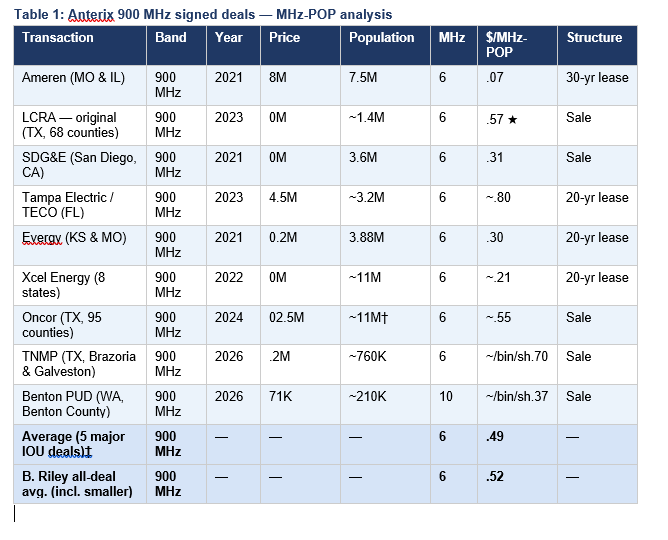
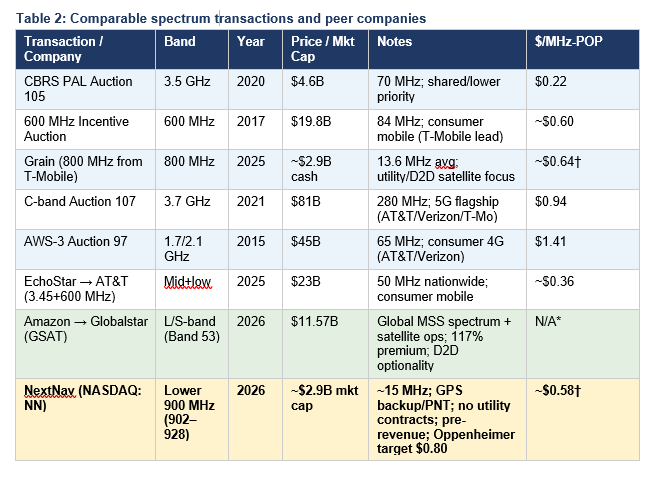
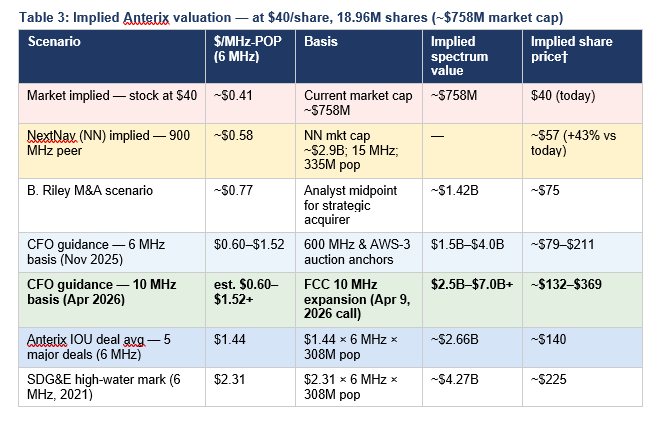
We present three analytical tables. Table 1 shows Anterix’s own signed deals — the most directly comparable transactions. Table 2 provides broader market context, including FCC auctions, the Amazon/Globalstar deal, Grain Management’s 800 MHz acquisition, and the crucial NextNav (NN) peer comparison. Table 3 shows implied company valuation and per-share price across scenarios, all calculated at the current price of $40 and 18.96 million shares outstanding.
Source: Anterix SEC Form 8-K filings; Light Reading; Evercore analyst note; B. Riley Securities research (March 2025); company confirmation (April 2026). MHz-POP calculations: author’s own. ★ = LCRA original (April 2023) is the highest $/MHz-POP deal on record at ~.57. † Oncor: company territory population is 13M but 95-county coverage population estimated at ~11M; author uses ~11M for MHz-POP. ‡ Average calculated on Ameren, SDG&E, Evergy, Xcel, and Oncor (the five largest investor-owned utility deals at 6 MHz). Benton PUD (10 MHz, rural county) and TNMP/LCRA (smaller or partial coverage) excluded from average as not directly comparable for pricing benchmarks.
Source: FCC public auction records (Auctions 97, 105, 107); EchoStar SEC Form 8-K (August 2025); Amazon press release (April 14, 2026); Bloomberg; Grain Management press release (March 20, 2025); Broadband Breakfast (April 1, 2026); TradingView/Oppenheimer (April 2026); IEEE ComSoc Technology Blog. † Author’s own MHz-POP calculations. * Amazon/Globalstar not directly comparable due to global MSS licence structure; shown for strategic context only. NextNav (NN): market cap ~$2.9B as of April 2026; estimated 15 MHz contiguous lower 900 MHz spectrum (902–928 MHz); different band and use case from Anterix (PNT/GPS backup vs. broadband); no utility contracts; pre-revenue; shown as 900 MHz band valuation reference only.
The NextNav (NASDAQ: NN) comparison deserves particular attention. NextNav holds approximately 15 MHz of lower 900 MHz band spectrum (902–928 MHz) and trades at a market capitalisation of approximately $2.9 billion — implying roughly $0.58/MHz-POP. This is 40% above Anterix’s current implied $/MHz-POP of $0.41. Yet NextNav has no utility contracts, generates essentially no revenue from its spectrum, and its business case depends on a speculative FCC rulemaking for GPS backup services that has yet to be approved. Anterix, by contrast, has $400M+ in contracted proceeds, 10 signed utility customers, and a proven commercial market. If Anterix were to trade at NextNav’s implied $/MHz-POP, the share price would be approximately $57 — already 43% above today’s level. Oppenheimer’s $0.80/MHz-POP target for NextNav, applied to Anterix’s 6 MHz position, implies an Anterix share price of approximately $120.
Source: † Per-share figures are author’s own calculations: ($/MHz-POP × 6 MHz × 308M US population covered) / 18.96M shares. CFO valuation ranges from Q2 FY2026 earnings call (November 13, 2025) and April 9, 2026 investor call. B. Riley $75/share from March 2025 research note. NextNav comparison: author’s own calculation applying NN’s implied $/MHz-POP to ATEX’s 6 MHz position. Deal average updated to $1.49 following company corrections (April 2026). Figures exclude cash (~$38M), TowerX/CatalyX revenue, and pipeline option value — spectrum value only; a floor estimate, not a ceiling. Not financial advice.
The most striking observation from Table 3: at $40/share, the market implies Anterix’s spectrum is worth $0.41/MHz-POP — well below NextNav’s implied multiple despite NextNav having no contracts, less than one-third of what every major Anterix utility customer has paid in arm’s-length transactions, and less than one-ninth of the LCRA deal, which stands as the highest $/MHz-POP transaction on record at $3.57. Management’s own $7 billion upper bound (10 MHz basis) implies a share price of $369. Even B. Riley’s conservative M&A scenario ($75/share) represents 88% upside from today.
Key Risks
Execution and pace: The $3B pipeline is not contracted. Utilities have been slow historical decision-makers, and conversion timelines are difficult to predict.
FCC licence delivery: Licences are granted county by county as incumbents are cleared. Anterix estimated in its 2020 shareholder letter that total clearing and licensing costs would range from $130–$160 million nationally. Complex-system counties — where operators with 45 or more integrated sites are exempt from mandatory retuning — require voluntary negotiation, which can be protracted and is not guaranteed to succeed on commercially acceptable terms.
Strategic review uncertainty: The Morgan Stanley process has run 14+ months with no announced deal. There is no guarantee it results in a transaction.
Cash runway: With ~$38M in cash and no debt, Anterix is dependent on contracted proceeds arriving on schedule. Operational discipline remains critical.
Liquidity and volatility: With ~18.96M shares outstanding and 90%+ institutional ownership, ATEX is thinly traded and susceptible to outsized price moves on news events.
Grain competition: Grain Management’s 800 MHz portfolio (acquired from T-Mobile for ~$2.9B) targets a similar utility customer base. While the bands differ in propagation characteristics and ecosystem maturity, Grain represents a credible competitive alternative for utilities evaluating private wireless options.
Satellite and consumer optionality remains speculative: The Lynk partnership and the Qualcomm consumer device roadmap are not contracted revenue. FCC approval for satellite D2D operations on 900 MHz is not guaranteed.
Summary: A De Facto Monopoly at a Rare Discount, With Multiple Expanding Catalysts
Anterix is not a conventional investment. Its value resides in its spectrum asset — a finite, legally protected nationwide spectrum franchise representing a de facto monopoly position that took a decade to build and cannot be replicated. The opportunity exists because most investors do not follow small-cap spectrum companies. A company whose own management describes its spectrum as worth $2.5 billion to over $7 billion trades at a market capitalisation of approximately $758 million.
When we last published ideas generating 500%+ returns, the common thread was a structurally mispriced asset with multiple catalysts converging. Anterix today presents more converging catalysts than any other opportunity we have seen:
The February 2026 FCC ruling doubled capacity and permanently expanded the addressable market.
The Qualcomm partnership (February 2026) brings 900 MHz into the consumer device chipset roadmap and signals a credible path to an Apple-like deal.
The Lynk Global experimental licence opens the satellite-to-consumer frontier on Anterix’s spectrum.
Amazon paid $11.57B for Globalstar (April 2026) at a 117% premium — confirming that the world’s largest technology companies pay extraordinary prices for irreplaceable licensed spectrum.
NextNav (NN) trades at ~$0.58/MHz-POP ($2.9B market cap) with no utility contracts, versus Anterix’s $0.41/MHz-POP with $400M+ contracted. The closest 900 MHz band peer is valued 40% higher despite having nothing comparable to show for it.
Grain Management paid ~$2.9B for 800 MHz utility-focused spectrum — a comparable low-band transaction at $0.64/MHz-POP versus Anterix’s implied $0.41.
The Morgan Stanley strategic review remains active, with management confirming ongoing inbound interest.
Management’s own spectrum valuation ($2.5B–$7B+) is 3–9x the current market cap of $758M.
For an investor with a 2–4 year horizon and tolerance for execution risk, ATEX offers an irreplaceable spectrum franchise with a structural moat, a live M&A process, a validated and growing customer base, three expanding market opportunities (utility, industrial/satellite, consumer), and a valuation that implies the market believes the spectrum is worth less than any comparable public auction or private transaction has ever suggested.
In a market where most “value” investments are commodities dressed as moats, Anterix has a real one: written into FCC regulations, validated by ten of America’s largest regulated utilities, deepened by Qualcomm’s chipset partnership, and now positioned at the frontier of the satellite direct-to-device revolution.
Important Disclaimer
This article is produced for informational and educational purposes only and does not constitute financial or investment advice. Spectrum valuations are inherently uncertain. Management estimates are forward-looking statements subject to material risks and uncertainties. Past deal prices are not guarantees of future transaction values. All numerical calculations are the author’s own unless otherwise noted. Readers should conduct their own due diligence and consult a qualified financial adviser before making investment decisions.
R+S Group ($RSGN), the European leader in electricity transformers, reported strong numbers.
The thesis is playing well, rerating in progress. Still a long way to go 24 CHF today vs 40 CHF in September, when it was valued in line with its peers. Congratulations to those who bought at 17 CHF with us.
Overall, the new figures reinforce our constructive stance on the company.
Operational EBITDA reached cCHF85m, corresponding to a margin of c20.5%
What stands out most is the very strong free cash flow generation. FCF of CHF48m significantly exceeded the Bernberg CHF16m estimate, pointing to solid working-capital discipline and strong cash conversion from earnings.
Robust cash generation allowed the company to delever the balance sheet much faster than we expected, with net debt declining to CHF63m or just 0.7x EBITDA, compared with the Bernberg estimate of 1.1x.
Order intake of CHF477m in 2025 resulted in a book-to-bill ratio of around 1.15x and lifted the backlog to CHF326m, providing solid revenue visibility into 2026 and, to a degree, 2027.
We would be buyers, as the case is being derisked. We are fully invested up to our max positioning.
Read the previous post here on R+S Group – includes the full investment thesis.
R&S Group Holding AG (SWX: RSGN) is a rare beast in Europe’s energy transition. It designs and builds medium- and high-voltage transformers. Its footprint spans Switzerland, Poland, Croatia, Ireland, and Finland. It serves utilities, industrial clients, and renewable developers.
The company is sitting on a huge structural tailwind. Europe’s grids are old, and demand for electricity is rising faster than ever. Renewable energy integration, electric vehicles, and digital infrastructure growth are pushing the need for more reliable transformers. R&S has the plants, the product range, and the long-term relationships to capture all of this demand.
Here’s the quick take:
Structural tailwinds: Grid renewal, EVs, data centers, and decentralized renewables support multi-year growth.
Revenue visibility: CHF 320m backlog covers most of FY 2026 production.
Valuation: Trades at ~11× EV/EBITDA 2026E vs. 17× for peers. Berenberg’s CHF 40 target implies >100% upside.
Market overreaction: A 30% drop after an “immaterial” guidance update creates a high-conviction buying window.
Company Overview
R&S isn’t just another industrial manufacturer. It is a full-service transformer solution provider. Its six plants give it geographic reach, operational flexibility, and risk diversification across multiple countries. This is particularly important in a sector where lead times matter and supply chain disruptions can impact delivery.
The 2024 Kyte Powertech acquisition expanded its footprint into higher-voltage applications. Combined with its existing portfolio—from 50 kVA to 250 MVA, including dry-type, cast-resin, and oil-filled transformers—R&S is one of the few mid-cap companies in Europe that can offer a complete, end-to-end solution.
Long-term contracts with national grids, industrial OEMs, and renewable developers provide recurring revenue streams. These contracts give the company high visibility into both volume and pricing, which is particularly valuable in a capital-intensive sector like transformer manufacturing.
Structural Tailwinds
The growth runway for R&S is extremely visible:
Grid renewal: Roughly 30% of Europe’s electricity grid is over 40 years old. Transformers are critical for replacing aging infrastructure. Many of these grids were built in the 1970s and 1980s. Without updates, reliability risks increase, especially as energy demand surges. R&S is perfectly positioned to benefit.
Electrification & data centers: EV adoption, heat pumps, and data-center expansion are driving electricity consumption higher. This creates both volume growth and pricing power for transformer manufacturers. Companies with the capacity to scale production while maintaining quality are rare, and R&S is one of them.
Decentralized renewables: Tens of thousands of new connection points across Europe are required for solar, wind, and other renewable projects. Each connection requires medium- or high-voltage transformers. For R&S, this translates into repeatable, long-term demand, particularly for high-margin cast-resin and oil-filled units.
Berenberg estimates that European grid investment could exceed €12 billion through 2027. That is a multi-year runway for R&S’s core products, ensuring sustained visibility into both revenue and margins.
Competitive Advantages
R&S has built a durable competitive moat.
Pan-European footprint: Six strategically located plants reduce logistics costs, speed delivery, and provide localized customer support. This also limits disruption risk from any single country.
Full product range: 50 kVA–250 MVA, dry-type, cast-resin, and oil-filled transformers. Customers can get everything from one supplier, which increases stickiness and recurring business.
Technology edge: High-value cast-resin transformers command premium margins. They also meet stringent environmental and safety standards, which increasingly matter to utilities and industrial clients.
Operational efficiency: The Poland Krzeczów facility and ongoing debottlenecking projects boost throughput, shorten lead times, and increase profit. Scale matters in this industry, and R&S has been relentless in improving efficiency.
These advantages allow R&S to maintain top-quartile margins and pricing discipline even in competitive markets and despite low-cost competition from Asia.
Operational Momentum & Backlog
R&S has a diverse customer base spanning national grids, renewable developers, and industrial OEMs.
Key points:
Backlog: CHF 320m, covering most of FY 2026 production. This gives the company both revenue visibility and leverage in pricing.
Revenue growth: Expected CAGR of 10–13% through 2027, supported by both price and volume.
Capacity utilization: Near 100% at key plants, highlighting the importance of ongoing capacity expansion.
Strong backlog coverage also allows R&S to pass on raw material cost inflation through contracts. This reduces earnings volatility and ensures consistent cash flow.
Operational and Financial Highlights
Metric
2024
2025E
2026E
2027E
Sales (CHF m)
283
421
468
510
EBITDA margin
23.9%
21.8%
21.0%
21.3%
EBIT margin
22.2%
19.7%
18.8%
19.0%
EPS (CHF)
1.25
1.58
1.71
1.92
Net debt / EBITDA
1.4×
1.0×
0.7×
0.2×
EV / EBITDA (2026E)
~10.9×
Peers ~17×
—
—
Source: Berenberg Initiation (Oct 2025) and Flash Update (Nov 2025)
Operational KPI
Metric
FY 2023A
FY 2024A
1H 2025A
FY 2025E
Order backlog (CHF m)
268
295
306
310 (E)
Revenue (CHF m)
239
282
156
315 (E)
YoY Growth (%)
—
+18%
+10% H1
+12% E
Capacity utilization (%)
~92
>95
~100
~100
Source: Berenberg Initiation (Oct 2025) and Flash Update (Nov 2025)
Capacity Expansion
R&S’s growth and margin resilience come from strategic capacity expansion.
Poland (Krzeczów): +40% capacity, focusing on distribution and cast-resin transformers. Faster delivery, lower costs.
Croatia & Switzerland: Debottlenecking and automation upgrades to increase throughput and standardize components.
Ireland (Kyte Powertech): Higher-voltage capabilities and diversification of revenue streams.
Overall, output is expected to rise >50% by 2027. Most of this expansion is already covered by confirmed orders, minimizing execution risk while protecting margins.
Margin Evolution
Margins remain strong due to a combination of product mix, operational scale, and plant efficiency.
Metric
FY 2023A
FY 2024A
FY 2025E
FY 2026E
FY 2027E
EBITDA margin (%)
18.6
20.0
20.8
21.1
21.2
EBIT margin (%)
16.0
18.4
19.2
19.8
20.0
ROCE (%)
49
55
58
60
60+
Source: Berenberg Initiation (Oct 2025) and Flash Update (Nov 2025)
High-value cast-resin units and ongoing operational improvements in Poland ensure margins remain near 20%, a rare combination of growth and profitability for mid-cap industrials.
Financial Strength
R&S has cleaned up its balance sheet, creating optionality for investors:
Metric
FY 2024A
FY 2025E
FY 2026E
FY 2027E
Net Debt / EBITDA (x)
1.3
0.8
0.4
0.2
Equity Ratio (%)
11
22
30
36
FCF Yield (%)
3.4
4.9
5.5
6.1
Source: Berenberg Initiation (Oct 2025) and Flash Update (Nov 2025)
Disciplined capex (~3–4% of sales) plus strong free cash flow sets up M&A or dividend potential post-2026.
Valuation
R&S trades at a deep discount to peers, despite top-quartile margins and strong visibility.
Metric (2026E)
R&S Group
Peer Median
Premium / Discount
EV / EBITDA (x)
10.9×
17.0×
-36%
P / E (x)
14.5×
23.8×
-39%
FCF Yield (%)
5.5%
3.2%
+71%
Source: Berenberg Initiation (Oct 2025) and Flash Update (Nov 2025)
Berenberg’s CHF 40 target comes from a DCF (70%) and 13× EV/EBITDA multiple (30%). At CHF 18.82, upside is >100%, with FCF yield >6%.
Recent Sell-Off
On 6 November 2025, R&S issued an “immaterial” guidance update. The stock fell ~30%.
We see this as a buying opportunity:
Structural tailwinds remain intact.
Backlog coverage protects revenue.
Valuation discount widens the upside.
Market reaction was overblown. Fundamentals haven’t changed, making this an ideal entry point for long-term investors.
Risks
Macroeconomics: Slow GDP growth could delay grid investments.
Regulatory: EU energy policies or subsidies may shift, affecting renewable integration timelines.
Supply chain & commodities: Copper, steel, and insulation material volatility can temporarily impact margins.
Currency: CHF reporting vs. EUR costs introduces FX risk.
Execution: Simultaneous plant expansions could cause temporary margin pressure.
These risks are manageable thanks to backlog coverage, pass-through contracts, and geographic diversification.
Investment Case Summary
R&S is a pure-play, defensive growth compounder with strong upside potential.
Driver
Impact
European grid renewal & electrification
Multi-year growth tailwind
Full FY 2026 backlog
Revenue visibility & pricing power
19–20% EBIT margin
Top-quartile profitability
Rapid deleveraging
Room for M&A/dividends
35–40% discount to peers
Re-rating potential
High scarcity value
Few pure-play listed EU transformer peers
Source: Berenberg Initiation (Oct 2025) and Flash Update (Nov 2025)
Conclusion
R&S Group is a rare mid-cap in Europe with pure exposure to energy transition themes. Integrated products, strong margins, backlog visibility, and a healthier balance sheet make it both defensive and high-growth.
With >100% upside to CHF 40, the recent pullback is a high-conviction entry point.
Disclosure: The author’s family office holds a long position in R&S Group Holding AG. Analysis based on publicly available information, including Berenberg research (Oct 2025 Initiation and Nov 2025 Flash Update).
The goal of the blog is to provide investment ideas for further research. I/we have a beneficial position in the shares discussed above either through stock ownership, options, or other derivatives. I wrote this article myself, and it expresses my own opinions. I am not receiving compensation for it. I have no business relationship with any company whose stock is mentioned in this article. The article does not represent investment advice. Please do your own research before making any investment action.
EOS is the most accurate in killing drones with bullets and lasers.
We have never lost any competitive trial for drone killing. We have not lost to Americans, Israelis, or anyone. In a recent competition in Israel, we were the only ones to shoot down 100% of the drones.
Andreas Schwer, CEO of EOS
Please look at the previous posts on EOS on this blog to see the full investment thesis.
Last week, German Broker Montega organised a call with EOS CEO Andreas Schwer. Below are the main quotes from the call and the presentation.
We have never lost any competitive trial for drone killing. We have not lost to Americans, Israelis, or anyone. In a recent competition in Israel, we were the only ones to shoot down 100% of the drones.
We have been selected by the US Army to use our weapon station for the next generation of tanks. We are the sole partner for this project.
With a laser, we can kill up to 30 drones per minute. With a bullet, we can kill 4-5 per minute.
Germany wants to spend up to 40 billion euros to protect its airspace. Drone defence should be a big part of that budget. We will be bidding for the segment.
We are the only ones who can deliver a 100kW laser together with Rafael. Three different parties own Rafael´s laser IP. EOS owns all IP for its laser weapon.
We can kill drones flying up to speeds of 500km/h
We can kill drones up to 3 km with a bullet, laser up to 6 km and 8 km with rocket systems.
We have the widest portfolio of Remote Weapon Stations; no one else has such a broad product range.
The most popular system is Slinger, developed to kill drones.
The latest product is R500—the next-generation system with all AI functionality. We are developing this with the US Army. All new generation tanks will be equipped with such a system.
Rheinmetal is selling the Skyranger with a 35mm cannon for 7 times the price of our system. Its accuracy is similar to our system. Skyranger uses a 35mm cannon, while we use a 30mm cannon, which is the NATO standard.
Skyranger costs 14 million USD. For that, you can buy 7 of our systems, and with those 7 systems, you can protect many more assets than with one Skyranger. Our system is also much lighter, so it can be mounted on any vehicle. Our system can kill drones at the same rate as Skyranger. So 7 systems can kill 7x as many drones as Skyranger.
We are working on improving our AI capabilities. We are in advanced negotiations, and we may announce an exciting AI deal in the next few months.
Our current AI capability enables us to link several Remote Weapon Stations. If a fleet of drones comes, the AI system will decide which RWS will kill which drone.
Our first 100kW laser was sold to the Dutch at 71 million euros (125 Australian dollars)
We will have a laser partnership by Q1 2026 to capture the French market.
The German parliament stopped the Rhinmetal contract, because we could deliver the system at half price and half the time. We will bid for the contract next year in an open competition.
Many governments have reached out to us for quotes on the laser weapon. Sales would be conducted using the same documentation we used for the Dutch sale – it is a NATO-standardised contract that any NATO state can use.
High-energy laser weapon – we are in negotiations with several parties. We see laser weapon annual revenues of 1.5-2 billion Australian dollars within 3 years with 15-20% EBITDA margins.
Space control is our future. We are the most advanced in Europe at shooting down satellites. Only two US companies can compete, but they will not deliver outside the US. We are the only ones in Europe. This will be an even bigger business for us than laser in the 2030s.
Our partners – we have partners in most countries where we deliver:
In Germany, our partner for RWS is Deal, and for laser, it is Helsing. For Space warfare is OHT.
France, KMDS is the partner for RWS.
In the UK, we are partnered with MSI, and we can not disclose the partner
In Italy, we are partners with Leonardo
We are in negotiations with more than 10 governments regarding the sale of laser weapons.
We hope the Dutch will buy an additional laser weapon next year for testing by their navy.
We are planning to conduct live laser and cannon testing next year in the UAE. That can generate even more interest. We will be inviting many global potential customers. It will be a significant event.
All our laser IP is in Singapore. The reason is that it is easier to export IPO from Singapore than from any other country.
The most significant hurdle for our future growth is human capital. We have received unsolicited offers from top engineers from our competitors. We have hired those highly sophisticated engineers. The reason is that they wanted their products in real life.
We are valued at only 700 million USD. We have had a couple of takeover conversations. I cannot disclose more, but we can be bought out of the market. If any firm offers come, the board will come. We would not submit any offer to the board below 10 dollars.
If we secure a contract pipeline of 40-50 laser weapons, the share price will be well above $ 20.
We are still early into our growth story. Our objective is 40-50 dollars, so investors have not missed anything yet. We are still very early and very affordable.
Do look at previous posts for more details on the EOS investment thesis.
Disclosure:
The goal of the blog is to provide investment ideas for further research. I/we have a beneficial position in the shares discussed above either through stock ownership, options, or other derivatives. I wrote this article myself, and it expresses my own opinions. I am not receiving compensation for it. I have no business relationship with any company whose stock is mentioned in this article. The article does not represent investment advice. Please do your own research before making any investment action.
EOS has the most accurate weapon for killing drones. They have the most precise weapon that kills Russian drones in Ukraine. The stock sold off 48% from its recent all-time high, together with similar defence stocks.
EOS is our top idea for the following year. Our base case is that the stock should triple over the period. The driver will be the European Drone Wall, as well as additional sales of its laser drone weapon.
Below is a copy of an email sent out by Fearnley Securities.
What’s happened?
EOS has seen a sharp drawdown, off 48% from its recent $10.42 high à the momentum and sentiment that took it to these highs came following the announcement of their recent $125m HELW contract with the Netherlands, a NATO country. Management have also publicly referred to many additional HELW opportunities, with multiple countries enquiring about large scale orders; South Korea and other EU nations.
Management have long cited that progress towards peace deals in Ukraine and the Middle East may contest with the sentiment that has driven capital allocation to defence stocks globally, however the fact remains that drones and drone warfare are now seemingly entrenched in daily life for Russia, Ukraine, and remain in the headlines across all of Europe.
HELW state of play and opportunities:
Since the initial announcement of the 100KW HELW contract, EOS have since announced that their ‘Apollo’ HELW is scalable to 150KW. While we have not seen additional HELW contracts for EOS, we note that the advent of HELW purchasing is increasing, which in our view underscores that these weapons are now widely accepted as commercially scalable defence solutions, and will be a core part of all militaries moving forwards.
A reminder; traditional kinetic interceptors are economically unsustainable when $1,000 drones require $500,000 missiles for defeat à Russia’s 28th Sept attack on Ukraine saw 600 drones wreak havoc across Kiev à this comes at the same time the US is mulling approval of a $90bn funding package for Ukraine.
Multiple HELW systems are transitioning from prototype to operational deployment in 2025-2027 timeframe à But EOS remains one of the only suppliers who can deliver 150KW units:
Israel Iron Beam: End 2025
UK DragonFire: 2027 on Royal Navy ships
US Army IFPC-HEL: 2024 prototypes, mass production mid-2020s
EOS Apollo: 2025-2028 delivery to European NATO state
Reminder of the EU opportunity for EOS:
EOS controls over 90% of its HELW intellectual property in-house, delivering a fully ITAR-free solution – a critical differentiator that eliminates U.S. export restrictions and enables flexible licensing across all EU countries, this positions EOS to offer:
Turnkey technology licensing to EU member state defense contractors.
Co-production agreements establishing HELW production lines within EU borders à reminder that EOS has already licensed its technology through its partnership with Diehl Defence GmbH in Germany.
Sovereign capability development meeting EU procurement preferences for 60% European-sourced defense equipment by 2030, and 40% of defense purchases be made through joint contracts by 2027.
The recent European Drone Defence Initiative (EDDI), released on the 16th October, outlines EU$800bn of funding to be allocated to developing technologies such as High Energy Laser Weapons/Directed Energy Weapons in Europe.
Disclosure:
The goal of the blog is to provide investment ideas for further research. I/we have a beneficial position in the shares discussed above either through stock ownership, options, or other derivatives. I wrote this article myself, and it expresses my own opinions. I am not receiving compensation for it. I have no business relationship with any company whose stock is mentioned in this article. The article does not represent investment advice. Please do your own research before making any investment action.
ShaMaran Petroleum (SNM.ST, SNM.CA) is poised for significant upside following the reopening of the Iraq-Turkey pipeline and the new export agreement.
SNM’s netbacks are set to nearly double in 2026, with free cash flow expected to exceed $200 million, enabling debt repayment and potential dividends or buybacks.
With a rerating to 6x FCF, SNM shares could see 100% upside in 12 months, supported by strong cash flow and shareholder returns.
ShaMaran Petroleum Corp. is poised to benefit from the reopening of the Iraq-Turkey pipeline, which will facilitate the export of oil from the Kurdistan region.
The pipeline reopened over the weekend, but the share price did not move much. The announced deal was more complex than the consensus expected. I read any research I could find on the resumption, but I did not understand what was going on and why the share price was not doubling. I spent the time to investigate. My take is that the market does not appreciate what is happening.
Surprisingly, the brokers are not providing much help; the research reports are quite unclear.
Introduction to ShaMaran Petroleum
ShaMaran Petroleum Corp. (OMX: SNM.ST, TSXV: SNM.CA) is an independent oil and gas company that produces from two adjacent blocks in the Kurdistan Region of Iraq. Shamaran is part of the Lundin Group, and the Lundin family is the largest shareholder, holding around a 30% stake, as well as the largest bondholder.
The Lundin family provides significant support to ShaMaran. William Lundin, who is on the board, bought ShaMaran shares in December 2024.
ShaMaran indirectly holds a 50% working interest (66.67% paying interest) in the Atrush Block and an 18% interest (22.5% paying interest) in the Sarsang Block.
Both assets are operated by the Ross Perot, Jr. company, HKN. The Perot family has a prominent Texas-based business with strong ties to Kurdistan and the Trump Administration. ShaMaran doubled its working interest production last year to over 20k barrels per day.
ShaMaran’s market capitalisation is around $600 million, and its net debt is $90 million. The stock is listed on the Canadian and Swedish exchanges. It is quite liquid, with a daily trading volume of around $1 million.
Why was the pipeline closed, and why did the reopening negotiations take so long?
The 2023 closure of the Iraq-Turkey pipeline resulted from a dispute between the Kurdistan Regional Government and the Iraqi central government over how Kurdistan’s oil revenues should be collected and shared.
Before the agreement was announced in September, the Kurdistan government collected about 50% of the take from all oil produced in Kurdistan. At the same time, Kurdistan was not funded from the central state budget.
Under the new agreement, Kurdistan relinquished all its oil revenues and will instead receive its share of the federal budget. Kurdistan has 14% of the population of Iraq, so it will get 14% of the federal budget, which is more than they have been making from oil under the old regime.
There is a significant mistrust between the central Iraqi government and the Kurdistan Regional Government. A considerable amount of time was spent on establishing a procedure to monitor actual oil sales, ensuring that no revenues would be missed.
What prices were ShaMaran selling while the pipeline WAS CLOSED?
In the first half of 2025, Shamaran sold to local traders and achieved revenue per barrel of $32 – $35. From this amount, the Kurdistan government took about 50%, so the actual net amount returned to ShaMaran was $16-$17.50. With a net production of over 20k barrels of oil per day, that is over $100 million in annual cash flow for ShaMaran.
What prices is ShaMaran selling after the pipeline REOPENED?
The parties agreed to establish an interim three-month mechanism to build trust between them.
Under the mechanism, ShaMaran would collect an initial payment of $16 per barrel, less a $2 transportation fee. During these three months, the contracts will be reviewed by Wood Mackenzie consultants. The interim period is expected to conclude in December. Wood MacKenzie is tasked to produce a certification of the process. After that is completed, ShaMaran will get a retrospective payment of an additional net $16 per barrel, approximately. The retrospective payments for deliveries made in 2025 should be paid out during the first quarter of 2026.
From January 2026, ShaMaran and others will collect the full market price for their oil, as per their contracts (more than $32 per barrel net back for ShaMaran). In summary, by 2026, the net realised price is expected to almost double compared to 2025.
The net backs and cash flow numbers mentioned in the text are an approximation based on current Brent oil prices.
ShaMaran terms provide them with the market price (Brent) for their oil, adjusted for oil quality (API) and transportation costs, so them net backs and cash flow will fluctuate with the oil price starting now.
What will be the impact of the pipeline reopening on ShaMaran’s FCF?
ShaMaran is a very lean producer. The lifting costs are very low, at $3-$5 per barrel, and the maintenance capital expenditure is also low, at $2 per barrel. ShaMaran was able to generate very healthy cash flows, even from local sales.
ShaMaran’s guidance is to generate FCF of $100 million in 2025. The FCF in 2026 is expected to more than double, exceeding $200 million, which will enable the company to repay all of its debt, initiate dividend payments, and/or repurchase shares.
Who will repay the old receivable that ShaMaran has from the Kurdistan Government?
When the pipeline closed, ShaMaran had $102 million in receivables from the Kurdistan Government. It was agreed that the receivables would remain the responsibility of the Kurdistan government. The debt is already being repaid – from $95 million at the end of 2023 to $69 million at the end of 2024 to $53 million as of the end of June 2025.
The receivable represents approximately 60% of ShaMaran’s net debt position of $90 million as of the end of June 2025.
What are the risks?
ShaMaran has a very strong balance sheet. Its net debt is only $90 million as of June, vs its $600 million market capitalisation. With the strong cash flow generation, ShaMaran is expected to be net cash positive by the first half of 2026 at the latest.
The consensus expected that ShaMaran would start selling oil at double prices from day one. It did happen, but in a structured way. The market was not prepared for this, and many retail investors might not have fully understood the deal.
One year before the pipeline reopened, ShaMaran was trading at 4 times FCF. If the exact multiple is maintained after the new process is certified and net realisable prices double, the share price should rerate at least by 30%.
Historically, Kurdistan producers have traded at a discount due to the perceived risk that the central Iraqi government would not recognise Kurdistan oil exports. Now that the central government has recognised their contracts, and Iraq is in charge of Kurdistan’s oil exports, the discount should be removed.
If the share price were to rerate to 6 times FCF, the upside potential increases to 100%.
Strong cash flow generation should enable ShaMaran to start buybacks and/or dividends as early as next year. That should further support the rerating. We see 100% upside potential in the next 12 months.
FCF
P/FCF
Mkt cap
Share price
$ million
$ million
SEK
Before reopening
100
4
400
1.3
Today
100
6
600
1.9
2026
200
3
600
1.9
2026
200
4
800
2.5
2026
200
5
1000
3.2
2026
200
6
1200
3.8
Source: our calculations
Conclusion
ShaMaran is a well-run company from the respected Lundin group. The pipeline reopening should double the price ShaMaran can collect for its oil. The price increase should more than double its FCF and its valuation.
Strong FCF should enable the company to become net cash positive during the first half of 2026. I expect dividends or buybacks possibly already in 2026.
We are proud to announce that we have been ranked the #1 best-performing idea generator by SumZero over the Last Twelve Months (LTM) category.
SumZero is the premier online community exclusively for professional investors, bringing together hedge fund, mutual fund, private equity, and proprietary trading professionals.
SumZero hosts a platform of peer-reviewed, long-form investment research contributed by more than 16,000 buyside members. Members gain access to over 12,000 detailed theses on publicly traded securities, offering transparency with disclosure of analyst and fund names, thorough valuation, risks, catalysts, and defined investment timeframes.
After ranking in the top ten over recent months, it is the first time we have reached the #1 spot.
We invite you to subscribe for free and stay connected to our latest investment ideas, market insights, and performance updates.
Disclosure:
The goal of the blog is to provide investment ideas for further research. I/we have a beneficial position in the shares discussed above, either through stock ownership, options, or other derivatives. I wrote this article myself, and it expresses my own opinions. I am not receiving compensation for it. I have no business relationship with any company whose stock is mentioned in this article. The article does not represent investment advice. Please do your own research before making any investment action.